What is Spotify Canvas?

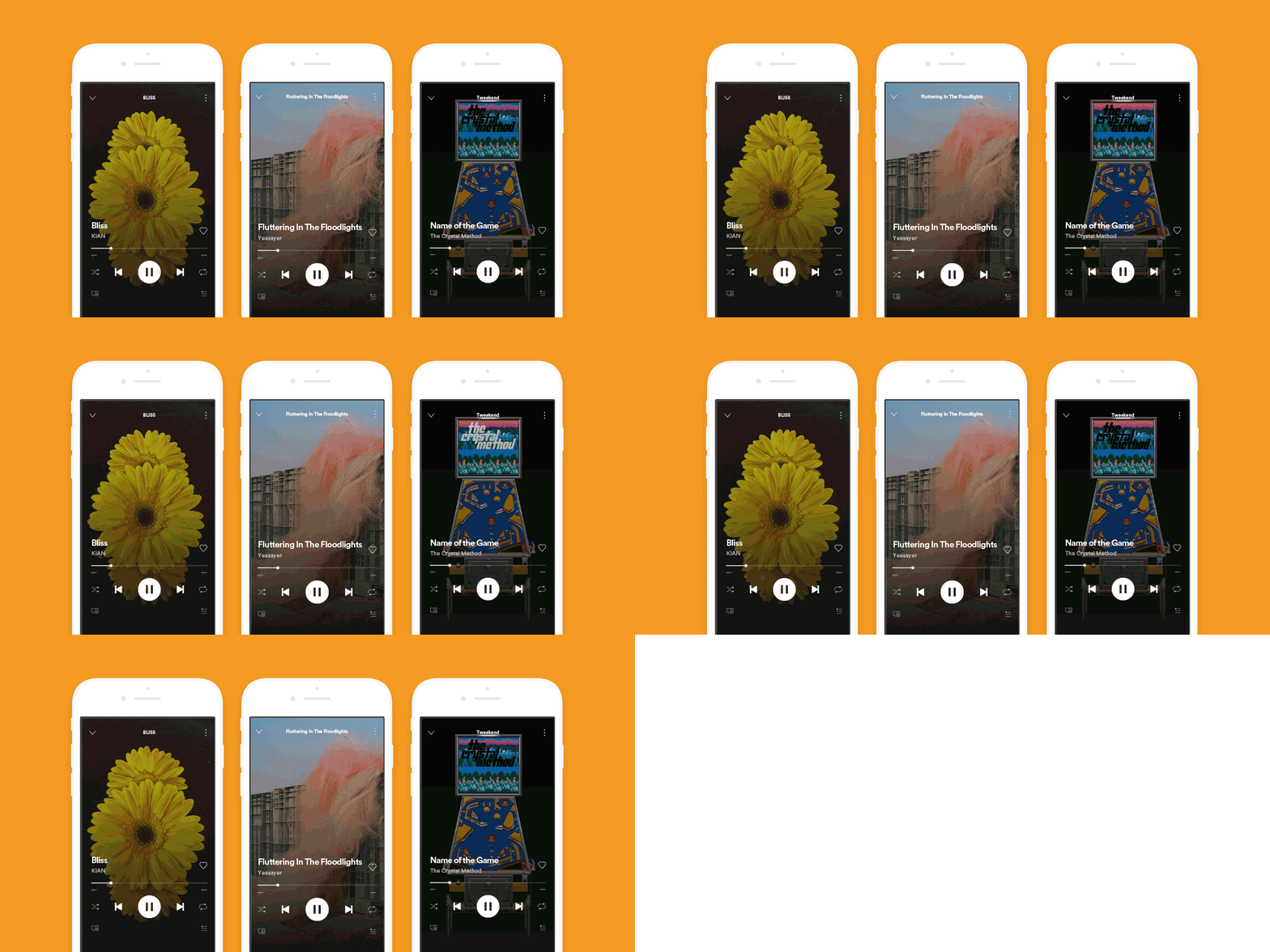
A Spotify Canvas is 3-8 second Spotify video loop shown on the mobile Spotify app while a song plays. They lie somewhere between album artwork and music videos, with examples ranging from a continuous loop of animation to simple repeating video clips. And, unlike album art, a Canvas Spotify video can be different for every song.
Well over half of Spotify subscribers listen with the mobile Spotify app (from 54% in Europe to 67% in Asia-Pacific), and in two short years, these Spotify music videos have became a firm favorite, so it’s an important part of your profile. And a lot of fun.
What’s in it for me?
Lots, but it boils down to this: A Spotify Canvas is a fantastic tool for getting more streams and building your fan base.
“When listeners see a Canvas, they are more likely to keep streaming (+5% on average vs. control group), share the track (+145%), add to their playlists (+20%), save the track (+1.4%), and visit your profile page (+9%).»
Just like album art or music videos, a great Canvas video on Spotify gets people talking, sharing your music, and, crucially, boosts your profile visits. And you can see this for yourself using Spotify for Artists stats.
How can I get Spotify Canvas?
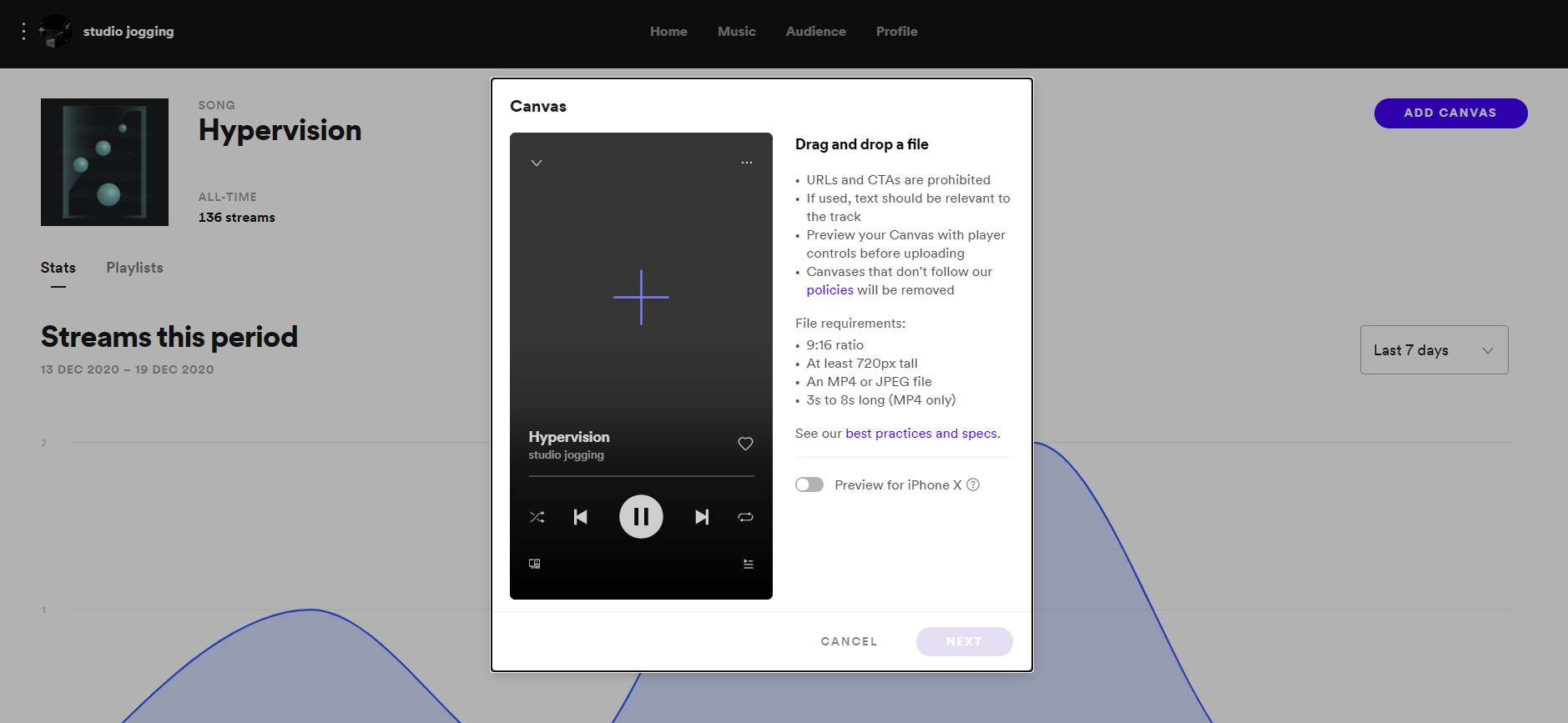
Our community often asks how to add Canvas on Spotify. The good news is, as an artist with music on Spotify or a Spotify subscriber, you already have the Spotify Canvas feature, it’s just a matter of creating a Canvas and adding it to a track. (To view Canvas as a listener, you might need to activate Canvas in your app Playback settings).
Spotify Canvases have simple but very specific file specifications: aspect ratio vertical 9:16, minimum height 720px, length 3-8 seconds and file format MP4 or JPG. If that makes your eyes water, don’t panic. There are plenty of free template-based options, suitable for beginners, and a slew of tutorial videos online for everything from formatting the media file to how to upload Spotify canvas videos. Alternatively, if you have a bit of budget (or generous talented friends), there’s no shortage of designers to be found online (Spotify even suggest a database of Canvas specialists).
How to Add Spotify Canvas to My Tracks
Adding your Canvas to a track is incredibly simple. You’ll need your phone for this as it can’t be done from the desktop version of Spotify for Artists.
What should I use for Spotify Canvas?
Pretty much anything you like. Video loops are great, but it could be a live gig clip, an animated version of your artist name, a squirrel pretending to be Prince – as long as it represents you and your music. Billie Eilish asked her fans to submit their own art, and selected some of those for her songs on Spotify.
Also, you must make your Canvas Spotify-friendly. So ensure you own any footage (or have permission) and please be aware that extreme content (such as poronography or hate speech/symbols) is not allowed. If you decide to use that looped video of the band skinny dipping in Iceland, don’t say we didn’t warn you…
Spotify themselves off a handy list of 10 things to try – and not to try:
Which are the best Spotify Canvases?
There are too many to scratch the surface (many featured in a 24 hour-long Canvas playlist). And while it’s no surprise that established art-driven bands like The Gorillaz have been quick to add amazing cartoons to their songs, cool things can be done on less Hollywood budgets too. Some cool examples include the Prodigy-esque video for Ellen Allien’s Körpermaschine and the Baditude EP by The Mayans, featuring a custom animation for the release.
How can I use Canvas as part of my social media?
You want to know how to share Spotify Canvas on instagram? Easily! Anybody – yourself included – can share your song Canvas to their Instagram story directly from the Spotify app. Tap the three dots next to the track listing and it’s right there alongside the other sharing options. And these shares will link directly back to your track.
Not only that, but there’s no limit to how many times you change a Canvas, so you could even create a series of Spotify video Canvas updates and share these, to celebrate a big event, an award, a certain number of streams, or even just ‘month two’!
All of this gives you another chance to get people sharing older songs again, and to interact with fans, thank them, or simply keep them interested.
Что такое canvas spotify
 Canvas — это функция Spotify, с помощью которой артисты могут загружать восьмисекундные зацикленные видео, чтобы сопровождать ими треки при воспроизведении в мобильном приложении сервиса. Его популярность неуклонно растет, и в начале этого года Spotify разрешили артистам делиться своими видео Canvas в сторис Instagram.
Теперь эта возможность есть и у слушателей. К 11 июня она будет развернута по всему миру в приложениях Spotify для Android и iOS. Если пользователь делится треком Spotify в сторис Instagram и если у него есть видео Canvas, то оно будет сопровождать ролик (длительность увеличена до 15 секунд для формата сторис).
Но согласно объявлению Spotify, «аудио для этой функции не предусмотрено», в то время как видео Canvas в сторис Instagram будут считаться только «просмотром» на аналитической панели Spotify for Artists, при условии воспроизведения полной версии песни на Spotify.
Этот аспект («без звука») иллюстрирует причудливую ситуацию, сложившуюся в мире лицензирования музыки. У Spotify есть лицензия на стриминг музыки, а Instagram — лицензия на использование музыки пользователями, но, похоже, что видео Canvas не относятся ни к одной из опций.
Если вы нашли ошибку, пожалуйста, выделите фрагмент текста и нажмите Ctrl+Enter.
Больше интересных новостей в нашем Telegram-канале. Подписывайся!
Что такое Spotify и чем он хорош


Содержание
Содержание
15 июля 2020 года в России наконец-то после нескольких лет переносов запустился музыкальный стриминговый сервис Spotify. Его ждали так долго, что за это время конкуренты, работающие в нашей стране, успели реализовать все его самые интересные функции. Поэтому возникает вопрос, а нужен ли пользователям новый музыкальный сервис при наличии «Яндекс.Музыки», «Музыки ВК»/«Boom», Play Музыки, Apple Музыки и прочих? Есть ли в Spotify что-то такое, за что его стоит не просто установить, но еще и оплатить подписку, дающую доступ ко всем функциям?
Что такое Spotify
Spotify — это самый первый в мире музыкальный стриминговый сервис, который появился в 2006 году. За это время Spotify пришел, наверное, на все возможные платформы, где можно обработать файлы с цифровым звуком и имеется усилитель с динамиком, чтобы играть треки.

За годы работы сервис накопил огромную библиотеку, в которой содержатся миллионы треков, причем их число постоянно растет.
Но основная «фишка» Spotify заключалась не в большой базе, а в умном сервисе рекомендаций и формирования плейлистов. Ориентируясь на то, какую музыку пользователь больше лайкает, сервис предлагает ему послушать другие треки, которые должны понравиться. Считается, что искусственный интеллект Spotify делает это лучше всех конкурентов. Как показало тестирование — это спорный момент, но тут все зависит от того, насколько много времени вы проведете в сервисе.

Еще один важный плюс Spotify — большое количество разнообразных и регулярно обновляемых плейлистов, в том числе мировых чартов и топов для всех стран, в которых присутствует сервис. Можно создавать и свои плейлисты, а потом делиться ими с миром. Spotify доступен в платной и бесплатной версиях. Бесплатная имеет ряд ограничений: не более шести перемоток треков за час, недоступно максимальное качество звука, нельзя прослушать треки оффлайн, есть реклама. В платной версии все это доступно, причем есть несколько вариантов подписки.
Кстати, для хорошей музыки могут пригодиться и хорошие наушники:
Основные возможности Spotify и сравнение с конкурентами
Разберем подробнее основные возможности, которые есть у Spotify и чем они отличаются от конкурентов.
Качество музыки
Начать надо с качества музыкальных треков. Пользователи могут выбрать несколько вариантов по качеству — от экономного для трафика битрейта 160 кбит/с до максимального 320 кбит/с (при условии наличия подписки). В Spotify используется формат файлов Ogg Vorbis, дающий по сравнению с mp3 лучшее качество звука при одинаковом битрейте.

На одинаковом оборудовании звук в Spotify при максимальном битрейте на одинаковых треках показался глубже и приятнее, чем в «Яндекс.Музыке» с включенным HQ. Остальные, в том числе Apple Music, Play Музыка, «Музыка ВК», звучали также хуже Spotify.

При этом в плане качества звука все перечисленные сервисы проигрывают Deezer, в котором при наличии подписки Deezer HiFi можно слушать треки в lossless-качестве в формате flac, звучащие объемнее. Правда, Deezer при отличном качестве треков проигрывает конкурентам в сервисе рекомендаций — основной «фишке» таких музыкальных проектов.
Музыкальные рекомендации
«Умные плейлисты», которые Spotify предлагает пользователю, сначала вас не удивят, потому что сервис не знает, какая музыка вам нравится. Для того, чтобы сервис начал предлагать адекватные настроению треки, ему надо подстроиться под персональные предпочтения. Но, у «Яндекс.Музыки» это получается быстрее. Она очень четко и быстро начинает предлагать треки под настроение и формировать интересный «Плейлист дня».

Spotify в этом плане первые две недели тестирования просто ставил в «умные плейлисты», треки групп, отмеченных как понравившиеся, немного разбавляя их другими. И только через пару недель «Мой микс дня» стал немного интереснее и разнообразнее. Кстати, Spotify предлагает пять таких разноплановых миксов на день, а «Яндекс.Музыка» — только один. Остальные «умные плейлисты» в «Яндекс.Музыке» формируются раз в неделю.

Интересная вещь, которая есть именно в Spotify, — регулярно обновляемые плейлисты чартов для всего мира и по разным странам. Такого нет в заточенной в основном на Россию «Яндекс.Музыке». В этом сервисе вообще имеется только один чарт, составленный на основе популярных у пользователей мелодий, хотя тематических плейлистов под разные настроения и вкусы довольно много. Поэтому в чартах Spotify очень хорош. Конкурентом в этом плане для Spotify является Apple Music, в котором также есть такая функция.
Полезная функция Spotify — «Радар новинок». В отличие от «Яндекс.Музыки», которая в плейлист новинок часто ставит ремиксы или недавно добавленные в сервис треки, хотя они на самом деле совсем не новые, Spotify составляет «Радар новинок» из недавно вышедших мелодий.
Отсутствие подкастов в российской версии
Нельзя не отметить, что в России Spotify запустился без подкастов, которые уже давно есть в «Яндекс.Музыке», реализованы в ВК и пользуются большой популярностью в Apple Музыке. Наверняка когда-то они появятся и в Spotify, потому что в международной версии подкасты есть. Но пока в российской версии их нет, и это минус.

Конечно, нам и так есть, где послушать «Брендятину» или лекции «Арзамаса», но если бы это было в российском Spotify, сервис стал бы интереснее и полноценнее. А так – «Яндекс.Музыка» опять оказывается на коне, потому что в ней всё это есть и сделано очень удобно, вплоть до плейлиста с наиболее популярными подкастами. Да и Apple Music с «Музыкой ВК» могут предложить тем, кто хочет послушать что-то занятное, но не музыкальное.
Spotify Connect
У Spotify есть интересная функция, которой нет у конкурентов — Spotify Connect. Если у вас есть несколько устройств, на которых может запускаться Spotify (ноутбук, компьютер, планшет, телевизор, игровая консоль), можно тапнуть на значок «Подключение к устройству» и выбрать тот гаджет, через который вы хотите запустить музыку. В результате музыка заиграет, например, не в вашем смартфоне, а в колонках или телевизоре.

Зачем это надо? Например, если вы хотите включить музыку для вечеринки. Или хотите одновременно слушать музыку и позвонить кому-то. А первое устройство, с которого запущено воспроизведение в этом случае можно использовать в качестве пульта. Получается что-то вроде «бесшовного» перехода с одного устройства на другое.
Про стоимость подписки
Первые три месяца Spotify, как и многие другие, предлагает пользоваться сервисом целиком и полностью бесплатно, а потом надо либо смириться с ограничениями, либо заплатить за премиум подписку.

Тарифы похожи на предложения конкурентов. «Яндекс.Музыка», «Apple Музыка», «Play Музыка» для одного пользователя стоят столько же. Отличия незначительны. Например, «Музыка ВК» просит 149 рублей за однопользовательскую подписку, а семейная подписка «Яндекс.Музыки» требует 299 рублей.
При этом необходимо отметить, что «Яндекс.Музыка» вообще-то берет 169 рублей не просто за подписку на музыкальный сервис, а за «Яндекс.Плюс». А это все-таки несколько больше, чем просто много музыки. « Яндекс.Плюс» это еще и скидки на такси, Кинопоиск, доставку еды, каршеринг, облачный Диск и прочие полезные плюшки.
Есть ещё один интересный вариант, которого нет в Spotify, как и в большинстве других стриминговых сервисов — это подписка Deezer HiFi в сервисе Deezer. Она стоит 255 рублей в месяц и дает доступ к трекам в формате flac. А это совсем другое качество звука и битрейт до 1411 кбит/с. Разница между 320 кбит/с, максимальными в других сервисах, с 1411 кбит/с в Deezer HiFi заметна «невооруженным ухом».
Резюме
На момент своего появления в России Spotify не является уникальным сервисом. Конкуренты предлагают неплохие альтернативы. Тем не менее, у Spotify есть ряд важных плюсов, которые могут заинтересовать поклонников музыки:
Spotify Canvas: How To Stand Out With Video and Find New Fans
Spotify’s newest feature—Canvas—makes it possible for artists to show their creative side, cement their aesthetic and delight their fans.
But, what exactly does Canvas do? And, how can you use it best?
In this article, we’ll unpack everything there is to know about using Spotify Canvas and help you start using it on your Spotify profile.
What is Spotify Canvas?
Spotify Canvas is a new feature on Spotify that makes it possible to add looping album artwork that plays when your songs are streamed.
With Canvas you may add a unique three to eight-second video for each track in an album, EP or single. These videos will play where the album artwork normally shows up when your track is streamed.
It’s a neat way to add 3D, 2D, video and hybrid media effects to your album artwork and entertain fans who stream your music.
You have the freedom to do whatever you want with it, which makes Canvas an incredible avenue for creative expression within your album artwork on Spotify.
How to use Spotify Canvas
Once you embrace a few important specifications, setting up Canvas videos for your Spotify tracks is easy.
Follow these 5 steps to update your album artwork with Canvas on Spotify.
1. Get verified on Spotify
If you haven’t claimed your Spotify for Artists profile, it’s highly recommended that you do so.
Claim your Spotify for Artists profile.
It’s the only way to get that blue verification checkmark and it’s the only way to upload Canvas art to your tracks on Spotify.
If you need help, we’ve written about getting verified on Spotify before.
Fortunately, if you release your music with LANDR Distribution your Spotify account will already be claimed and it’s just a matter of logging in to your account.
2. Film in a 9:16 aspect ratio
Remember, your Canvas will replace your album artwork, so, you need to create your video content in a phone-friendly 9:16 aspect ratio format.
3. Make sure your pixel height is a minimum of 760px
Unless it’s an aesthetic choice, you don’t want your artwork to be all pixelated and grainy.
That’s why you must submit a Canvas that’s a minimum pixel height of 760px.
But consider using a much higher pixel height to guarantee your Canvas will display properly on retina display phone screens.
Consider using a much higher pixel height to guarantee your Canvas will display properly on retina display phone screens.
Remember, the Canvas you upload will exist behind the play and skip controls at the bottom of the screen so keep the main part of your video focused on the center where it’ll display best.
4. Film a 3-8 second video
Spotify Canvas artwork is a looping video that does not sync with your lyrics or track.
The length of your video loop may range from three to eight seconds.
That’s plenty of time to put in some psychedelic artwork effects or a trippy looped video.
Just don’t expect your Canvas to match the rhythm of your track or sync with your lyrics.
5. Upload your video in your Spotify for Artists profile
Once you have a video ready, you may upload it to the correct album or single through your Spotify for Artists profile.
Once you’re logged into Spotify for Artists:
Congratulations, you just made the experience of enjoying your music that much more awesome!
5 Cool Spotify Canvas Ideas to Make Your Video Pop
With Canvas you’re no longer limited to a square box to showcase your artistic brand and style.
Now you can show interesting and engaging video content alongside your music.
Here are a few creative ideas to get the most of your Spotify Canvases.
1. Work with a video designer to create something truly awesome
If the idea of having to invent and create a looping video makes you nervous, there’s help out there for you.
This is the kind of creative work motion graphics designers and video creatives love to do.
This is the kind of creative work motion graphics designers and video creatives love to do.
There’s plenty of online marketplaces where you can find and hire creatives to help you with your vision.
LANDR Network for example is a great place to link up with creatives who love working with musical artists and will understand your vision.
2. Don’t worry about showing your lyrics, artist, track or album name
Spotify will always display your artist name, track name and album name within its app interface.
So unless you want to use some kind of aesthetic typography, don’t worry about making sure your Canvas has album or artist information on it—it’s really designed for visuals only.
Of course, if you want your lyrics to show when your track is played we’ve explained how you can put lyrics on Spotify in previous articles.
3. Say more about yourself and your album
Help your albums, EPs and singles tell a story by creating a unique canvas for each track that follows an overarching theme.
I’m sure you already know your aesthetic, so use Canvas to play to your strong suits and show your fans what your music is all about!
4. Experiment with different loop styles
There’s different ways to take advantage of looping video.
You could create a psychedelic and satisfying seamless loop. Take inspiration from those cool seamless loops that go viral on Instagram from time to time.
Or, you could use a loop that cuts at a funny point to create a certain effect, whether it’s meant to be humorous or jarring.
And of course, there’s the classic boomerang effect where your loops transition between forward and reverse.
5. Try different visual media
Don’t pigeonhole yourself into only using live-action video. A simple phasing texture, 3D animation or 2D gif are great options.
A simple phasing texture, 3D animation or 2D gif are great options.
There’s tons of inspiration out there on the internet for trippy animations, so get creative!
The world is your Canvas
Streaming platforms don’t have to be a cold and utilitarian place.
Canvas helps you liven up your presence on Spotify and it’s definitely something to take advantage of, especially if your music adheres to a strong aesthetic.
We can’t wait to see the cool visual art your inventive mind comes up with for your next Canvas.
Spotify’s Business Strategy Case Study
Spotify business model canvas


Spotify’s Company Overview
Spotify is a music, podcast, and video streaming service, officially launched on 7 October 2008. It is developed by startup Spotify AB in Stockholm, Sweden. It provides digital rights management-protected content from record labels and media companies. Spotify is a freemium service, meaning that basic features are free with advertisements, while additional features, including improved streaming quality and offline music downloads, are offered via paid subscriptions.
Foundations date: 2006
Sector: Information & Media
Spotify’s Customer Needs
Life changing: affiliation/belonging
Emotional: rewards me, design/aesthetics, badge value, fun/entertainment, attractiveness, provides access
Functional: makes money, saves time, simplifies, reduces effort, organizes, integrates, reduces cost, quality, variety, organizes, avoids hassles, sensory appeal
Spotify’s Related Competitors
Spotify’s Business Operations
Access over ownership:
The accessibility over ownership model is a business concept that allows consumers to utilize a product without owning it. Everything serves a purpose. As a result, consumers all across the Western world are demanding more value from their goods and services, and they are rethinking their relationship with stuff.’ Furthermore, with thriving online communities embracing the idea of access above ownership, the internet is developing as a robust platform for sharing models to expand and prosper.
This approach generated money by sending promotional marketing messages from other businesses to customers. When you establish a for-profit company, one of the most critical aspects of your strategy is determining how to generate income. Many companies sell either products or services or a mix of the two. However, advertisers are frequently the source of the majority of all of the revenue for online businesses and media organizations. This is referred to as an ad-based income model.
Multiple products or services have been bundled together to enhance the value. Bundling is a marketing technique in which goods or services are bundled to be sold as a single entity. Bundling enables the purchasing of several goods and services from a single vendor. While the goods and services are often linked, they may also consist of different items that appeal to a particular market segment.
It requires workers to live brand values to solve issues, make internal choices, and provide a branded consumer. Developing a distinctive and enduring cultural brand is the advertising industry’s holy grail. Utilizing the hazy combination of time, attitude, and emotion to identify and replicate an ideology is near to marketing magic.
It primarily offers free services to users, stores their personal information, and acts as a platform for users to interact with one another. Additional value is generated by gathering and processing consumer data in advantageous ways for internal use or transfer to interested third parties. Revenue is produced by either directly selling the data to outsiders or by leveraging it for internal reasons, such as increasing the efficacy of advertising. Thus, innovative, sustainable Big Data business models are as prevalent and desired as they are elusive (i.e., data is the new oil).
A digital strategy is a strategic management and a business reaction or solution to a digital issue, which is often best handled as part of a broader company plan. A digital strategy is frequently defined by the application of new technologies to existing business activities and a focus on enabling new digital skills for their company (such as those formed by the Information Age and frequently as a result of advances in digital technologies such as computers, data, telecommunication services, and the World wide web, to name a few).
This pattern is based on the capacity to convert current goods or services into digital versions, which have several benefits over intangible products, including increased accessibility and speed of distribution. In an ideal world, the digitalization of a product or service would occur without compromising the consumer value proposition. In other words, efficiency and multiplication achieved via digitalization do not detract from the consumer’s perceived value. Being digitally sustainable encompasses all aspects of sustaining the institutional framework for developing and maintaining digital objects and resources and ensuring their long-term survival.
Keeping the purchase price low by avoiding mediators and maximizing supply margins is a win-win situation. In finance, disintermediation refers to how money is removed from intermediate financial organizations such as banks and savings and loan associations and invested directly. Disintermediation, in general, refers to the process of eliminating the middleman or intermediary from future transactions. Disintermediation is often used to invest in higher-yielding securities.
A disruptive technology supplants an existing technology and fundamentally alters an industry or a game-changing innovation that establishes an altogether new industry. Disruptive innovation is defined as an invention that shows a new market and value network and ultimately disrupts an established market and value network, replacing incumbent market-leading companies, products, and alliances.
Disrupts by offering a better understanding that customers are willing to pay for. Experience companies that have progressed may begin charging for the value of the transformation that an experience provides. An experienced company charges for the feelings consumers get as a result of their interaction with it.
This model is used to describe a pricing system that charges a single flat price for service regardless of its actual use or duration. A company may establish a responsible position in a market if customers get excellent pricing before performing the service. The consumer benefits from a straightforward cost structure, while the business benefits from a predictable income stream.
Freemium is the sum of the words free and premium and refers to a business strategy that provides both free and premium services. The freemium business model works by providing essential services for free and charging for enhanced or extra capabilities. This is a typical practice among many software firms, who offer imperative software for free with restricted functionality, and it is also a popular approach among game developers. While everyone is invited to play the game for free, extra lives and unique game features are accessible only once the player buys.
A hidden revenue business model is a revenue-generating strategy that excludes consumers from the equation, preventing them from paying for the service or product provided. For example, users of Google do not pay for the search engine. Rather than that, income streams are generated via advertising dollars spent by companies bidding on keywords.
Ingredient branding is a kind of marketing in which a component or ingredient of a product or service is elevated to prominence and given its own identity. It is the process of developing a brand for an element or component of a product in order to communicate the ingredient’s superior quality or performance. For example, everybody is aware of the now-famous Intel Inside and its subsequent success.
The long tail is a strategy that allows businesses to realize significant profit out of selling low volumes of hard-to-find items to many customers instead of only selling large volumes of a reduced number of popular items. The term was coined in 2004 by Chris Anderson, who argued that products in low demand or with low sales volume can collectively make up market share that rivals or exceeds the relatively few current bestsellers and blockbusters but only if the store or distribution channel is large enough.
Mass customization is a strategy that entails using modular goods and manufacturing processes to allow efficient product individualization. Mass customization refers to producing customized output using flexible computer-aided manufacturing systems in marketing, manufacturing, contact centers, and management. Mass customization is the next frontier for manufacturing and service sectors alike. Beyond the physical product, mass customization is utilized by a diverse variety of software products and services with the goal of developing strong connections with customers via personalization and suggestion.
Micro-segmentation is a more sophisticated type of segmentation in which a small number of consumers are classified into very accurate categories based on various variables, including behavioral forecasts. Customer micro-segmentation is the process of segmenting a firm’s customers into groups based on their relationship with that business. The purpose of segmenting customers is to determine how to relate to each segment’s customers to optimize each customer’s value to the company.
The on-demand economy is described as economic activity generated by digital marketplaces that meet customer demand for products and services via quick access and accessible supply. The supply chain is managed via a highly efficient, intuitive digital mesh built on top of current infrastructure networks. The on-demand economy is transforming commercial behavior in cities worldwide. The number of businesses, the categories covered, and the industry’s growth rate are all increasing. Businesses in this new economy are the culmination of years of technological progress and customer behavior change.
Businesses use the open business approach to incorporate goods and services ecosystems from third parties that operate inside the same market framework. Collaboration between companies has the potential to increase the value delivered to the end customer or user. Software developers and platform integrators often use this business model.
Orchestrators are businesses that outsource a substantial portion of their operations and processes to third-party service providers or third-party vendors. The fundamental objective of this business strategy is to concentrate internal resources on core and essential functions while contracting out the remainder of the work to other businesses, thus reducing costs.
Product innovation is the process of developing and introducing a new or better version of an existing product or service. This is a broader definition of innovation than the generally recognized definition, which includes creating new goods that are considered innovative in this context. For example, Apple launched a succession of successful new products and services in 2001?the iPod, the iTunes online music service, and the iPhone?which catapulted the firm to the top of its industry.
In most instances, support is not intended to be philanthropic; instead, it is a mutually beneficial commercial relationship. In the highly competitive sponsorship climate of sport, a business aligning its brand with a mark seeks a variety of economic, public relations, and product placement benefits. Sponsors also seek to establish public trust, acceptability, or alignment with the perceived image a sport has built or acquired by leveraging their connection with an athlete, team, league, or the sport itself.
Subscription business models are built on the concept of providing a product or service in exchange for recurring subscription income on a monthly or annual basis. As a result, they place a higher premium on client retention than on customer acquisition. Subscription business models, in essence, concentrate on revenue generation in such a manner that a single client makes repeated payments for extended access to a product or service. Cable television, internet providers, software suppliers, websites (e.g., blogs), business solutions providers, and financial services companies utilize this approach, as do conventional newspapers, periodicals, and academic publications.
Historically, the fundamental principles for generating and extracting economic value were rigorous. Businesses attempted to implement the same business concepts more effectively than their rivals. New sources of sustained competitive advantage are often only accessible via business model reinvention driven by disruptive innovation rather than incremental change or continuous improvement.
New technologies that are now being created or produced in the next five to ten years will significantly change the economic and social landscape. These include but are not limited to information technology, wireless data transmission, human-machine connection, on-demand printing, biotechnology, and sophisticated robotics.
Trialware is software that has an expiration date. The user may use the software fully featured until the trial time expires. At this point, it reverts to a limited functionality (freemium, nagware, or crippleware) or non-functional mode until the user pays the licensing price and gets a registration code to unlock the program. Trialware has established itself as the industry standard for an online software as a Service (SaaS).
Two-sided marketplaces, also called two-sided networks, are commercial platforms featuring two different user groups that mutually profit from the web. A multi-sided platform is an organization that generates value mainly via the facilitation of direct contacts between two (or more) distinct kinds of connected consumers (MSP). A two-sided market enables interactions between many interdependent consumer groups. The platform’s value grows as more groups or individual members of each group use it. For example, eBay is a marketplace that links buyers and sellers. Google connects advertising and searchers. Social media platforms such as Twitter and Facebook are also bidirectional, linking consumers and marketers.