Discourse Management/Interactive Communication


LAW SCHOOL
DEPARTMENT OF CUSTOMS BUSINESS
(2 nd year)
THE ENGLISH LANGUAGE
Syllabus
February 2018 –July 2018 Semester
| Instructor: | Alla Viktorovna Belousova |
| Contact: | http://vk.com/Englishsfu |
| Course Location: | Auditoriums 4-18, 4-04 6 Maerchaka-Street |
| Course Description: | It is a multi-skills course and it aims at developing the student’s proficiency in language and communication skills. The course is designed to provide intensive listening, speaking, reading and writing in English at intermediate level. |
Course books:
Белоусова А. В., Здолбицкая М. Ю., Суворова С. И. Английский язык для таможенников. Красноярск: СФУ. 2015.
Useful Resources:
1. English Vocabulary in Use. Elementary. by M. McCarthy, F. O’Dell. CUP, 2000. 168 p.
2. English Vocabulary in Use. Upper Intermediate & Advanced. by M. McCarthy, F. O’Dell. CUP, 2001.
3. Raymond Murthy English Grammar in Use. A self-study reference and practice book for intermediate students. Cambridge University Press, 2010.
4. Rets, N. I. Drugs: Teaching Aids / N. I. Rets. Moscow, 2003. 107 p.
5. UK Import and Export Statistics / CD ROM. England: Business and Trade Statistics, 2004.
14. http://jobsearch.about.com/od/jobapplicationletters/a/letter-of-applica tion-guidelines.htm
Brief Course Outline (36 contact hours)
| Week | Units | Speaking Topics/Writing |
| 1. 05.02 – 10.02 | Revision. | Speaking: Agreeing and disagreeing. Sharing opinions. |
| 2. 12.02 – 17.02 | Grammar Practice. Non-verbals. | Writing: Inserting prepositions. Filling in the table. Filling in the gaps. |
| 3. 19.02 – 24.02 | ||
| 16. 21.05– 26.05 | ||
| 17. 28.05–02.06 | ||
| 18. 04. 06–09.06 |
Course Requirements
| 1. Portfolio of written assignments | Writing (4 assignments) |
| Vocabulary Lists | |
| Speaking / Writing | |
| Listening | |
| Use of English | |
| Reading | |
| Control | Examination |
Current assessed work can include quick checks, recorded pair or individual talk or any other task which you will be informed about in advance.
Timely submission of all the tasks is obligatory. Late submission (though within a week time) will be scored lower. Late work without a request and a reasonable explanation will not be scored. In ALL circumstances it is the student’s responsibility to inquire about missed work.
Class Attendance Policy:
Regular class attendance is expected as is preparation for in-class cases and activities. I reserve the right to subtract up to 30% of a student’s final grade for engaging in what I believe is poor class attendance and preparation. I will, throughout the course, provide feedback to any student who I feel may be the object of this penalty so that appropriate behavioural changes can be made by that student to avoid the penalty.
Examination.
1. Written translation of the text focusing on professional activity.
2. Reading (Extracting required information from the text connected with professional activity).
List of topics:
2. The purpose of establishing of free zones; location of free zones.
3. Distinction between commercial and industrial free zones.
4. Operations performed with goods in commercial and industrial free zones.
5. Advantages of industrial free zones for the development of a country.
6. Export incentives.
7. Opportunities, provided by the International Convention (the Kyoto convention) to simplify customs procedures.
8. Drawbacks in a customs procedure.
9. Temporary admission and duty-free replacement of goods.
10. The role of customs. Problems facing customs administration today.
11. The complexity of customs regulations.
12. Promoting higher standards of protection of intellectual property by European Union.
13. Customs of the XXIst century.
14. The necessity of customs change in order to remain competitive in the global economy and changing political environments.
15. The key to the changes in customs.
16. Globalization and seriousness of security threats.
18. The department you study at.
19. What other customs departments you know.
20. Qualifications, legal skills, appropriate experience which can be acquired there.

21. The subjects you are to study.
22. Your future career.
23. Your future specialization.
24. Explain your choice.
25. Innate qualities necessary for a good customs official.
26. The plan of achievement of your career goals.
27. The admission into the US.
28. What the inspection process is.
29. Difference between a US citizen and an alien.
30. The reasons of declining.
31. CBP (customs and border protection) officers.
32. CBP officer`s duties.
33. Requirements for customs officer`s job.
34. CBP officer`s Training Centre.
Five analytical criteria:
1. Task realization
Discourse Management/Interactive Communication
Grammatical Resource
Lexical Resource
Pronunciation
| 1. Task realization | ▪ Has the task been fully or partially completed? ▪ Would a target listener be satisfied with a topic development? |
| 2. Discourse Management | Student ▪ Organises ideas clearly and effectively for each task. ▪ Can sustain a conversation which is relevant to the themes or arguments of each task. ▪ Can speak fluently without long pauses or lots of hesitations. |
| 3. Interactive Communication | Student ▪ Can help another speaker to develop his/her discussion more effectively. ▪ Can make an appropriate contribution to a discussion by providing feedback (e.g., short questions, regular function words/phrases like Really, etc), back channelling or asking relevant questions. ▪ Uses a polite but friendly semi-formal tone throughout each of the tasks. ▪ Uses appropriate conversational formulas. |
| 4. Grammatical Resource | Student ▪ Demonstrates a range of grammatical structures to deal effectively with each task. ▪ Uses a range of grammatical structures appropriately. ▪ Uses both simple and complex grammatical structures accurately. |
| 5. Lexical Resource | Student ▪ Uses a range of vocabulary to deal effectively with each task. ▪ Can find a range of vocabulary to deal with unfamiliar topics. ▪ Uses complex phrases (e.g. common collocations) as well as single items of vocabulary effectively. |
| 6. Pronunciation | Student ▪ Can speak clearly and intelligibly on the topics and themes of each task. ▪ Can use stress and intonation appropriate to the meaning of a sentence. ▪ Can produce individual sounds sufficiently clearly so that one word is not confused with another. |
Writing
Do not use the Translator. Otherwise your mark will be reduced. Pay attention to lexical and grammatical form of the letter. The examiner awards marks according to five analytical criteria:
What Is Discourse Management?
Join the Community

Discourse management is the ability to direct written or spoken conversation in a specific direction. It refers to how much language occurs, as well as how relevant and cohesive the language is. Although discourse management raises issues of freedom of expression, it is a common tool used in everyday conversation, business and academics.
As a tool, discourse management relies on the principle that language and discourse are inextricably connected. Language provides the direction for any discourse that occurs, with the interpretation of language depending largely on cultural contexts. By understanding culture and gaining control over the language, a person can control how discourse proceeds.
Discourse may be written, such as with letters or email, and it may also be spoken, such as with conversation. In either case, discourse management is useful for preventing or repairing communication breakdowns. For instance, a person might ask another person to clarify what he meant so that confusion doesn’t make conversation inefficient or create conflict.
Ultimately, the ability to manage discourse allows a person to exercise some degree of power over the responses of others. This, in turn, can control how people behave. People who want to manage one or more people often have to learn how to control what is said or written in a particular environment. In a very mild form, discourse management might mean phrasing a question to elicit a particular response. In more severe cases, it can mean outright partial or complete censorship.
The ability of discourse management to create power hierarchies and prevent the written or spoken word from taking a specific direction raises some concerns about freedom of expression. In particular, the freedom of speech is called into question. In some nations, laws provide little if any protection against blatant discourse management and censorship. In other nations, laws guaranteeing freedom of speech are present, but might not be enforced in every instance due to cultural or environmental factors. An example is an employee who does not say how upset she is with her boss because she fears retaliation or a schedule or workload that is more difficult.
The act of managing discourse can occur in everyday conversation in private conversation as well as in businesses and academic institutions. For instance, companies might choose to use words with specific connotations during a layoff to make the company’s situation seem less desperate and keep morale up. In the classroom, discourse management is necessary to get students to go through learning processes and arrive at the correct answers. In this sense, discourse management is not necessarily bad, because the intent behind it is to build up others or prevent anxiety and chaos.
Как оценивают экзамены PET, FCE, CAE и CPE
Как оценивают экзамены PET, FCE, CAE и CPE
С 2015 года приходится пользоваться специальной шкалой, которую придумали для международных экзаменов Cambridge English. Даже переименовали сами экзамены для подростков и взрослых. Теперь есть по два названия на каждый:
Так как я не готовлю к KET, писать о нем подробно я не буду. Моя зона ответственности — PET, FCE и CAE. А CPE будет моей следующей и последней ступенькой по официальным уровням английского. Поэтому я захватываю оценивание последних четырех экзаменов. Информация о переводе баллов основана на документе с сайта cambridgeenglish.org. Вы его найдете, если сделаете в поисковике запрос на английском Converting practice tests scores to Cambridge English Scale Scores. Если не найдете, напишите мне — я пришлю вам.
Общий балл по FCE, CAE и CPE
Баллы для каждого экзамена распределили по оценкам и поместили в шкалу Cambridge English. Информация эта приблизительная и не гарантирует такой же результат на самом экзамене. Зато можно узнать, над чем работать дальше после выполнения Cambridge English Practice Tests.
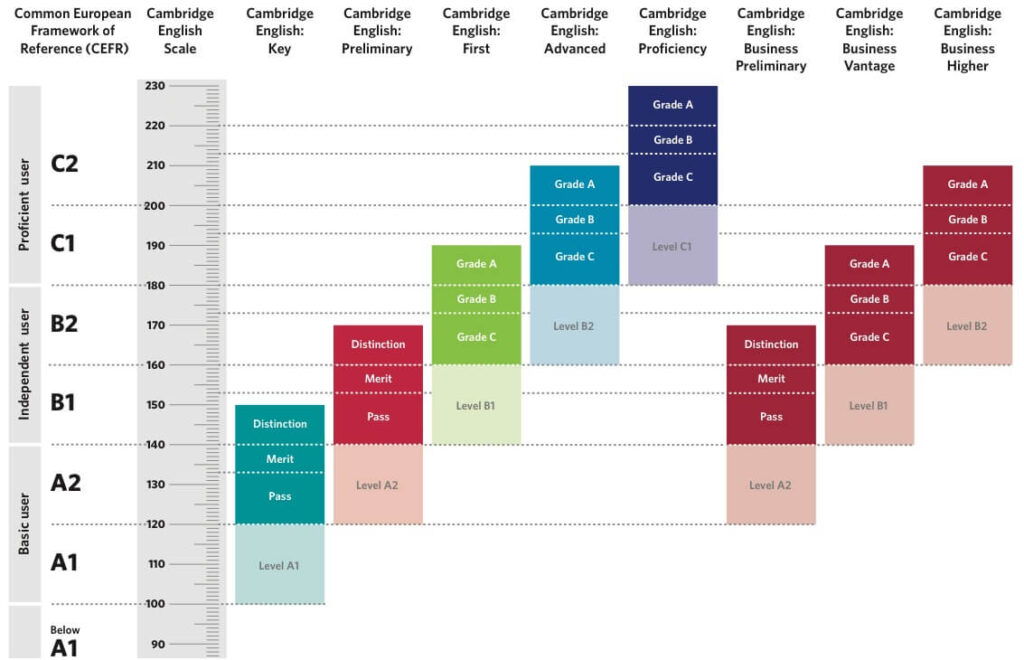 Соотношение уровней CEFR, баллов и оценок по экзаменам. Такая шкала есть практически на каждой странице сайта Cambridge English
В PET есть четыре части — Reading, Writing, Listening and Speaking. За каждую кандидат получает баллы, которые нужно сложить и разделить на четыре. С FCE, CAE и СPE история похожая, только складываются результаты пяти частей (Reading, Use of English, Writing, Listening и Speaking) и делятся на пять.Тогда получаются общий балл и оценка из таблицы.
Когда результат будет меньше баллов на Grade C, то выдается сертификат на уровень ниже. В табличке эти баллы помечены более прозрачным цветом. Оценка А приравнивается к более высокому уровню. Например, вы получили Grade A по FCE, уровень B2. Значит, в сертификате напишут следующий уровень — С1.
Помимо общих данных в сертификат записывают информацию по каждой части. Чтобы приблизительно знать результат, нужно проявить гениальный талант в работе с мозгом, ручкой и калькулятором.
Не стоит бояться, что вы «завалили» одну-две части и получили на несколько баллов меньше проходного. Главное — получить в общей сумме не меньше 140 по PET, 160 по FCE, 180 по CAE и 200 по CPE.
Speaking и Writing в PET, FCE, CAE и CPE
Говорение и письмо оценивают сертифицированные экзаменаторы по довольно сложным критериям. Я имею отношение к устному экзаменаторству. Поэтому из личного опыта могу сказать, что самостоятельно такие навыки измерить сложно. Но основная информация еще никому не помешала. Примерно можно понять, в каком состоянии находятся говорение и письмо по формату.
В посте я упоминаю измерители для подсчета, но не разъясняю их. Почитать о них и формате заданий вы можете в «Handbook for Teachers». Такая книга есть для каждого экзамена на сайте Cambridge English.
Результаты по каждой части PET
Эта разбалловка касается формата PET до 2020 года. Дальше уже будет немного другая шкала, которую я не буду здесь приводить. Моя программа Preliminary закрыта.
Чтобы рассчитать результат, нужно знать, сколько баллов дается за каждое правильно выполненное задание.
Для Reading нужны части 1–5 в Reading and Writing. За каждый правильный ответ дается 1 балл. Максимум за чтение — 35.
Writing. Задания 6–8 в Reading and Writing. Задание 6 — 1 балл. Задания 7 и 8 оцениваются экзаменаторами по критериям. Максимум за письмо — 25 баллов.
Listening. 1 балл за правильный ответ. Всего — 25.
В Speaking два экзаменатора дают разные оценки. Разговаривающий с кандидатами (Interlocutor) ставит 0-5 баллов за Global Achievement. Его нужно умножить на 2.
Заполняющий форму (Assessor) работает с четырьмя параметрами и ставит 0-5 баллов за каждый:
Максимум за говорение — 30 баллов.
Набранные баллы называются Practice Test Scores. В таблице вы видите их приблизительное соотношение с конечным результатом по каждой части Cambridge English Scale Score и уровнями CEFR. Чтобы сдать тест, нужен общий балл 140 из суммы баллы всех четырех частей.
PET/ PET for Schools (Preliminary English Test)
160–170 Pass with Distinction (что-то вроде «отлично», максимальный балл)
153–159 Pass with Merit (как «хорошо»)
140–152 Pass («сдано»).
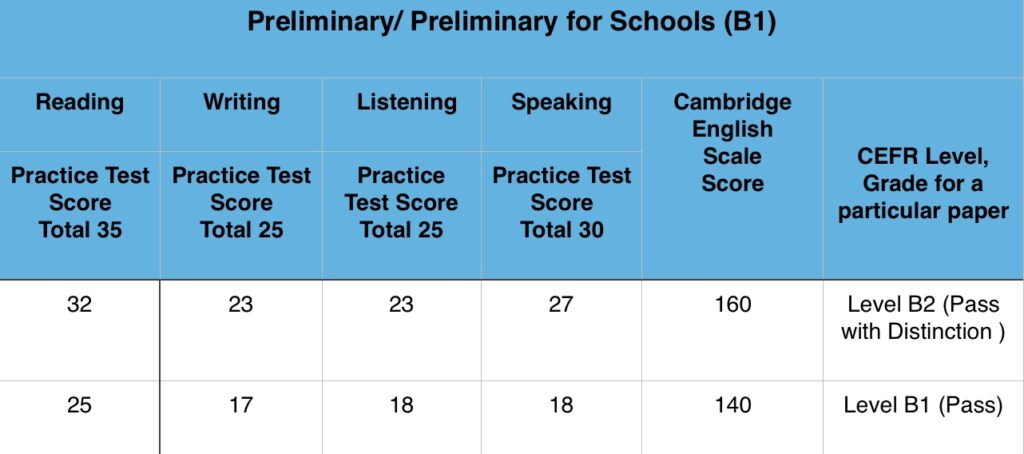 Баллы в таблице — минимум для Pass and Pass with Distinction. Чтобы посчитать баллы для Pass with Merit, отнимите от чисел верхней строчки 1-2 балла.
Результаты по каждой части FCE
Задания Reading надо взять из Reading and Use of English:
Задания для Use of English тоже берутся из Reading and Use of English:
Каждый параметр в Writing может получить по 5 баллов: Content, Communicative Achievement, Organisation, Language.
Две части — по 20 баллов. Максимум получается 40.
В Listening 30 вопросов — 1 балл за каждый верный ответ.
На Speaking приходится пять критериев. Разговаривающий с кандидатами (Interlocutor) ставит 0-5 баллов за Global Achievement, который умножается на 4.
Заполняющий форму (Assessor) работает с четырьмя параметрами и ставит 0-5 баллов за каждый:
Оценки по каждому этому пункту умножаются на 2.
Пример:
Global Achievement 3×4 =12
Grammar and Vocabulary 4×2=8
Discourse Management 5×2=10
Pronunciation 3×2=6
Interaction communication 4×2=8
Итого: 12+8+10+6+8=34.
Максимум 60 баллов за говорение.
Полученные Practice Test Scores переводятся в примерный Cambridge English Scale Score и соотносятся с уровнями CEFR. Если вы набрали 160 баллов из суммы баллов пяти частей, то экзамен вы сдали.
FCE/ FCE for Schools (First Certificate in English)
180–190 Grade A (как «отлично»)
173–179 Grade B (как «хорошо»)
160–172 Grade C («сдано»).
 Баллы в таблице — минимум для Pass и Pass A. Чтобы посчитать баллы для Pass B, отнимите от чисел верхней строчки 1-3 балла для Reading, 1-2 для остальных.
Результаты по каждой части CAE
Reading подсчитывают по результатам заданий 1, 5, 6, 7, 8 из Reading and Use of English:
Use of English состоит из заданий 2, 3 и 4 из Reading and Use of English:
В Writing можно получить максимум 40 баллов по 20 баллов за каждое задание.
У Listening 30 вопросов — 1 балл за каждый верный ответ
На Speaking приходится пять критериев. Разговаривающий с кандидатами (Interlocutor) ставит 0-5 баллов за Global Achievement, который умножается на 5.
Заполняющий форму (Assessor) работает с пятью параметрами и ставит 0-5 баллов за каждый:
Оценки по каждому этому пункту умножаются на 2.
Пример:
Global Achievement 4×5 =20
Grammatical Resource 4×2=8
Vocabulary Resource 4×2=8
Discourse Management 5×2=10
Pronunciation 4×2=8
Interaction communication 4×2=8
Итого: 20+8+8+8+10+8+8=62.
Максимум получается 75 баллов.
Баллы Practice Test Scores переводятся в примерный Cambridge English Scale Score и соотносятся с уровнями CEFR. Общий балл из суммы баллов всех разделов распределяется по оценкам.
CAE (Certificate in Advanced English)
200–210 Grade A
193–199 Grade B
180–192 Grade C.
 Баллы в таблице — минимум для Pass и Pass A. Чтобы посчитать баллы для Pass B, отнимите от чисел верхней строчки 1-3 балла для Reading, 1-2 для остальных.
Результаты по каждой части CPE
В Reading нужны задания 1, 5, 6 and 7 из Reading and Use of English:
Use of English включает части 2, 3 и 4 из Reading and Use of English:
В Writing набирается максимум 40 баллов по 20 баллов на каждое задание. Формат и критерии подробно расписаны в Handbooks for Teachers для Proficiency.
Максимум 30 баллов по Listening, по 1 баллу за каждый верный ответ
На Speaking работают 5 параметров. Разговаривающий с кандидатами (Interlocutor) ставит 0-5 баллов за Global Achievement, который умножается на 5.
Заполняющий форму (Assessor) работает с пятью критериями и ставит 0-5 баллов за каждый:
Оценки по каждому этому пункту надо умножить на 2.
Пример:
Global Achievement 4×5 =20
Grammatical Resource 4×2=8
Vocabulary Resource 4×2=8
Discourse Management 5×2=10
Pronunciation 4×2=8
Interaction communication 4×2=8
Итого: 20+8+8+8+10+8+8=62.
Максимально количество баллов за говорение — 75.
Подсчитанные Practice Test Scores переводятся в примерный Cambridge English Scale Score и соотносятся с уровнями CEFR. Вот так распределяется общий балл по оценкам.
CPE (Certificate of Proficiency in English)
220–230 Grade A
213–219 Grade B
200–212 Grade C. 
Баллы в таблице — минимум для Pass и Pass A. Чтобы посчитать баллы для Pass B, отнимите от чисел верхней строчки 1-3 балла для Reading, 1-2 для остальных.
Таблички — мои и с сайта Cambridge English.
Discourse Management/Interactive Communication
LAW INSTITUTE
DEPARTMENT OF CUSTOMS BUSINESS
THE ENGLISH LANGUAGE
Syllabus
February 2017 –July 2017 Semester
| Instructor: | Alla Viktorovna Belousova |
| Contact: | http://vk.com/Englishsfu |
| Course Location: | Rooms 4-18, 1-25 6 Maerchaka-Street |
| Course Description: | It is a multi-skills course and it aims at developing the student’s proficiency in language and communication skills. The course is designed to provide intensive listening, speaking, reading and writing in English at intermediate level. |
Белоусова А. В., Здолбицкая М. Ю., Суворова С. И. Английский язык для таможенников. Красноярск: СФУ. 2015.
1. English Vocabulary in Use. Elementary. by M. McCarthy, F. O’Dell. CUP, 2000. 168 p.
2. English Vocabulary in Use. Upper Intermediate & Advanced. by M. McCarthy, F. O’Dell. CUP, 2001.
3. Raymond Murthy English Grammar in Use. A self-study reference and practice book for intermediate students. Cambridge University Press, 2010.
4. Rets, N. I. Drugs: Teaching Aids / N. I. Rets. Moscow, 2003. 107 p.
5. UK Import and Export Statistics / CD ROM. England: Business and Trade Statistics, 2004.
14. http://jobsearch.about.com/od/jobapplicationletters/a/letter-of-applica tion-guidelines.htm
Brief Course Outline (36 contact hours)
Course Requirements
| 1. Portfolio of written assignments | Writing (4 assignments) |
| 2. Current Work | Vocabulary Lists |
| Speaking / Writing | |
| Listening | |
| Use of English | |
| Reading | |
| Control | Examination |
Current assessed work can include quick checks, recorded pair or individual talk or any other task which you will be informed about in advance.
Timely submission of all the tasks is obligatory. Late submission (though within a week time) will be scored lower. Late work without a request and a reasonable explanation will not be scored. In ALL circumstances it is the student’s responsibility to inquire about missed work.
Class Attendance Policy:
Regular class attendance is expected as is preparation for in-class cases and activities. I reserve the right to subtract up to 30% of a student’s final grade for engaging in what I believe is poor class attendance and preparation. I will, throughout the course, provide feedback to any student who I feel may be the object of this penalty so that appropriate behavioural changes can be made by that student to avoid the penalty.
Examination.
1. Written translation of the text focusing on professional activity.
2. Reading (Extracting required information from the text connected with professional activity).
2. The purpose of establishing of free zones; location of free zones.
3. Distinction between commercial and industrial free zones.
4. Operations performed with goods in commercial and industrial free zones.
5. Advantages of industrial free zones for the development of a country.
6. Export incentives.
7. Opportunities, provided by the International Convention(the Kyoto convention) to simplify customs procedures.
8. Drawbacks in a customs procedure.
9. Temporary admission and duty-free replacement of goods.
10. The role of customs. Problems facing customs administration today.
11. The complexity of customs regulations.
12. Promoting higher standards of protection of intellectual property by European Union.
13. Customs of the XXIst century.
14. The necessity of customs change in order to remain competitive in the global economy and changing political environments.
15. The key to the changes in customs.
16. Globalization and seriousness of security threats.
18. The department you study at.
19. What other customs departments you know.
20. Qualifications, legal skills, appropriate experience which can be acquired there.
21. The subjects you are to study.
22. Your future career.
23. Your future specialization.
24. Explain your choice.
25. Innate qualities necessary for a good customs official.
26. The plan of achievement of your career goals.
27. The admission into the US.
28. What the inspection process is.
29. Difference between a US citizen and an alien.
30. The reasons of declining.
31. CBP (customs and border protection) officers.
32. CBP officer`s duties.
33. Requirements for customs officer`s job.
34. CBP officer`s Training Centre.
Task realization
Discourse Management/Interactive Communication
Grammatical Resource
Lexical Resource
Pronunciation
| 1. Task realization | ▪ Has the task been fully or partially completed? ▪ Would a target listener be satisfied with a topic development? |
| 2. Discourse Management | Student ▪ Organises ideas clearly and effectively for each task. ▪ Can sustain a conversation which is relevant to the themes or arguments of each task. ▪ Can speak fluently without long pauses or lots of hesitations. |
| 3. Interactive Communication | Student ▪ Can help another speaker to develop his/her discussion more effectively. ▪ Can make an appropriate contribution to a discussion by providing feedback (e.g., short questions, regular function words/phrases like Really, etc), back channelling or asking relevant questions. ▪ Uses a polite but friendly semi-formal tone throughout each of the tasks. ▪ Uses appropriate conversational formulas. |
| 4. Grammatical Resource | Student ▪ Demonstrates a range of grammatical structures to deal effectively with each task. ▪ Uses a range of grammatical structures appropriately. ▪ Uses both simple and complex grammatical structures accurately. |
| 5. Lexical Resource | Student ▪ Uses a range of vocabulary to deal effectively with each task. ▪ Can find a range of vocabulary to deal with unfamiliar topics. ▪ Uses complex phrases (e.g. common collocations) as well as single items of vocabulary effectively. |
| 6. Pronunciation | Student ▪ Can speak clearly and intelligibly on the topics and themes of each task. ▪ Can use stress and intonation appropriate to the meaning of a sentence. ▪ Can produce individual sounds sufficiently clearly so that one word is not confused with another. |
Writing
Не используйте переводчик, в противном случае оценка за письмо будет снижена. Будьте внимательны при лексическом и грамматическом оформлении письма!
Ваше письмо будет оцениваться по 5 аналитическим критериям:
1. Решение коммуникативной задачи (содержание)
Организация текста
Лексика
Грамматика
Орфография и пунктуация
По каждому критерию Вы можете получить максимум 3 балла. (итого максимум 15 баллов). Письмо будет оценено «неудовлетворительно», если в целом Вы получите 0-8 баллов.