nominal GDP
Смотреть что такое «nominal GDP» в других словарях:
Comparison between U.S. states and countries nominal GDP — This is a comparison between US states and countries nominal Gross Domestic Product. Many of the states of the United States have large Gross Domestic Product (called gross state product) which would rank highly on a list of countries world GDP.… … Wikipedia
GDP deflator — In economics, the GDP deflator (implicit price deflator for GDP) is a measure of the change in prices of all new, domestically produced, final goods and services in an economy. GDP stands for gross domestic product, the total value of all final… … Wikipedia
Nominal income target — A nominal income target is a potential policy conducted by a central bank to target the future level[1] of economic activity in nominal terms (ie. not adjusted for inflation). The central bank could target Gross domestic product (NGDP) or Gross… … Wikipedia
Nominal (disambiguation) — A nominal is one of the parts of speech. Nominal may also refer to: Nominal aphasia, a problem remembering words and names Nominal category, a group of objects or ideas that can be collectively grouped on the basis of shared, arbitrary… … Wikipedia
Nominal Value — The stated value of an issued security. Nominal value in economics also refers to a value expressed in monetary terms for a specific year or years, without adjusting for inflation. When used in reference to securities, nominal value is also known … Investment dictionary
GDP Deflator — A price index applied to the cash or nominal estimates of gross domestic product in order to produce a more accurate or real value of GDP. Deflators remove the effects of inflation, which boosts the nominal value of GDP but does not change the … Financial and business terms
Measuring GDP — Gross domestic product, GDP, is defined as the total value of all goods and services produced within that territory during a given year. GDP is designed to measure the market value of production that flows through the economy. Includes only goods … Wikipedia
List of Indian states by GDP — States and territories of India by: Area Population Highest Point GDP HDI Tax revenues Voters Abbreviations … Wikipedia
nominal GDP
1 nominal GDP
2 nominal GDP
3 Nominal GDP
См. также в других словарях:
Comparison between U.S. states and countries nominal GDP — This is a comparison between US states and countries nominal Gross Domestic Product. Many of the states of the United States have large Gross Domestic Product (called gross state product) which would rank highly on a list of countries world GDP.… … Wikipedia
GDP deflator — In economics, the GDP deflator (implicit price deflator for GDP) is a measure of the change in prices of all new, domestically produced, final goods and services in an economy. GDP stands for gross domestic product, the total value of all final… … Wikipedia
Nominal income target — A nominal income target is a potential policy conducted by a central bank to target the future level[1] of economic activity in nominal terms (ie. not adjusted for inflation). The central bank could target Gross domestic product (NGDP) or Gross… … Wikipedia
Nominal (disambiguation) — A nominal is one of the parts of speech. Nominal may also refer to: Nominal aphasia, a problem remembering words and names Nominal category, a group of objects or ideas that can be collectively grouped on the basis of shared, arbitrary… … Wikipedia
Nominal Value — The stated value of an issued security. Nominal value in economics also refers to a value expressed in monetary terms for a specific year or years, without adjusting for inflation. When used in reference to securities, nominal value is also known … Investment dictionary
GDP Deflator — A price index applied to the cash or nominal estimates of gross domestic product in order to produce a more accurate or real value of GDP. Deflators remove the effects of inflation, which boosts the nominal value of GDP but does not change the … Financial and business terms
Measuring GDP — Gross domestic product, GDP, is defined as the total value of all goods and services produced within that territory during a given year. GDP is designed to measure the market value of production that flows through the economy. Includes only goods … Wikipedia
List of Indian states by GDP — States and territories of India by: Area Population Highest Point GDP HDI Tax revenues Voters Abbreviations … Wikipedia
Номинальный валовой внутренний продукт
Опубликовано 05.07.2021 · Обновлено 05.07.2021
Что такое номинальный валовой внутренний продукт?
Номинальный валовой внутренний продукт – это валовой внутренний продукт (ВВП), оцениваемый в текущих рыночных ценах. ВВП – это денежная стоимость всех товаров и услуг, производимых в стране. Номинальный отличается от реального ВВП тем, что он включает изменения цен из-за инфляции, которая отражает скорость роста цен в экономике.
Ключевые выводы
Общие сведения о номинальном валовом внутреннем продукте
Номинальный ВВП – это оценка экономического производства в экономике, которая включает в свой расчет текущие цены. Другими словами, он не исключает инфляцию или темпы роста цен, которые могут привести к завышению показателя роста. Все товары и услуги, учитываемые в номинальном ВВП, оцениваются по ценам, фактически проданным в этом году.
Влияние инфляции на номинальный ВВП
Поскольку он измеряется в текущих ценах, рост номинального ВВП из года в год может отражать рост цен, а не рост объема производимых товаров и услуг. Если все цены повышаются более или менее вместе, что называется инфляцией, тогда номинальный ВВП будет казаться выше. Инфляция является негативной силой для участников экономической деятельности, поскольку снижает покупательную способность доходов и сбережений как для потребителей, так и для инвесторов.
Инфляция обычно измеряется с помощью индекса потребительских цен (ИПЦ) или индекса цен производителей (ИЦП). ИПЦ измеряет изменения цен с точки зрения покупателя или их влияние на потребителя. ИЦП, с другой стороны, измеряет среднее изменение отпускных цен, которые выплачиваются производителям в экономике.
Когда общий уровень цен в экономике повышается, потребители вынуждены тратить больше, чтобы купить такое же количество товаров. Если доход человека увеличивается на 10% за определенный период, но инфляция также увеличивается на 10%, то реальный доход (или покупательная способность) человека не изменится. Термин «реальный» в реальном доходе просто отражает доход после вычитания инфляции из этой цифры.
Номинальный ВВП по сравнению с реальным ВВП
Точно так же, если бы мы сравнивали рост ВВП между двумя периодами, номинальный рост ВВП мог бы завышать рост, если присутствует инфляция. Экономисты используют цены на товары за базовый год в качестве ориентира при сравнении ВВП одного года с другим. Разница в ценах базового года и текущего года называется дефлятором цен ВВП.
Например, если цены выросли на 1% по сравнению с базовым годом, дефлятор ВВП будет равен 1,01. В целом, реальный ВВП – лучший показатель в любое время, когда сравнение проводится за несколько лет.
Реальный ВВП начинается с номинального ВВП, но учитывает любые изменения цен от одного периода к другому. Реальный ВВП рассчитывается путем деления общего объема производства на ВВП на дефлятор ВВП.
Например, предположим, что номинальный выпуск ВВП в текущем году составил 2 000 000 долларов, в то время как дефлятор ВВП показал увеличение цен на 1% по сравнению с базовым годом. Реальный ВВП будет рассчитан как 2 000 000 долларов США / 1,01 или 1 980 198 долларов США в год.
Одно из ограничений использования номинального ВВП – это когда экономика находится в состоянии рецессии или периода отрицательного роста ВВП. Отрицательный рост номинального ВВП мог быть вызван снижением цен, называемым дефляцией. Если цены снижались более быстрыми темпами, чем рост производства, номинальный ВВП мог бы отражать общие отрицательные темпы роста экономики. Отрицательный номинальный ВВП будет сигнализировать о рецессии, когда в действительности рост производства был положительным.
Nominal Gross Domestic Product
What is Nominal Gross Domestic Product (Nominal GDP)?
Nominal Gross Domestic Product (Nominal GDP) is the total market value of all goods and services produced in a country’s economy over a given period. Unlike other GDP measurements, nominal GDP is not adjusted to account for price changes from inflation Inflation Inflation is an economic concept that refers to increases in the price level of goods over a set period of time. The rise in the price level signifies that the currency in a given economy loses purchasing power (i.e., less can be bought with the same amount of money). and deflation.
It means that it rises and falls (usually rises) with the change in price and economic output in an economy. In the real world, the nominal GDP is usually used to compare GDP to other economic variables that do not adjust for inflation, including debt.
Key Difference Between Nominal GDP and Real GDP
Real GDP is another measurement of economic activity but differs slightly from nominal GDP in use and measurement.
Nominal GDP is an economic measure that does not account for changes in the price level. In other words, it is the market value of all final goods and services Products and Services A product is a tangible item that is put on the market for acquisition, attention, or consumption while a service is an intangible item, which arises from in an economy over a period. If prices were to change, but the economic output was to remain constant, then the nominal GDP would change – that is why the metric is sometimes misleading to economists and investors.
In contrast, real GDP accounts for changes in price that may occur due to inflation or deflation. A simpler way to understand real GDP is to think of it as nominal GDP that’s been adjusted for changes in price.
Real GDP will either use the prices in a base year or a GDP Deflator to account for the changes in price. In doing so, economists and investors can gain a better idea of the real change in economic activity in a given period.
Some common misconceptions about nominal GDP are:
1. An increase in nominal GDP means an increase also in economic activity.
Since nominal GDP accounts for all final goods and services in an economy at current market prices, growth in this economic measure can be attributed to either an increase in quantity or price.
As such, it is hard to determine which of these factors is responsible for the increase in nominal GDP, so economists and investors will usually adjust it to account for the change in price levels.
2. It is easy to compare nominal GDP measures over time.
When comparing GDP figures from different time periods, economists and investors will usually use real GDP Nominal GDP vs. Real GDP Nominal Gross Domestic Product (GDP) and Real GDP both quantify the total value of all goods produced in a country in a year. However, real because it removes changes in prices that might have occurred (which shows the real change in economic output).
It would be difficult to use nominal GDP because it considers the change in economic output and prices. However, economists and investors will use nominal GDP when comparing economic output in different quarters within the same year.
Calculating Nominal Gross Domestic Product
There are a few ways to calculate the nominal Gross Domestic Product:
1. Expenditure Approach
GDP = C + I + G + (X – I)
The expenditure approach accounts for both quantity changes and prevailing market prices, and thus, is a suitable way to measure nominal GDP.
2. GDP Deflator Approach
Nominal GDP = Real GDP x GDP Deflator
The GDP Deflator approach requires knowledge of the real GDP level (output level) and the change in price (GDP Deflator). When you multiply both elements, the result is the nominal GDP.
GDP Deflator: An In-depth Explanation
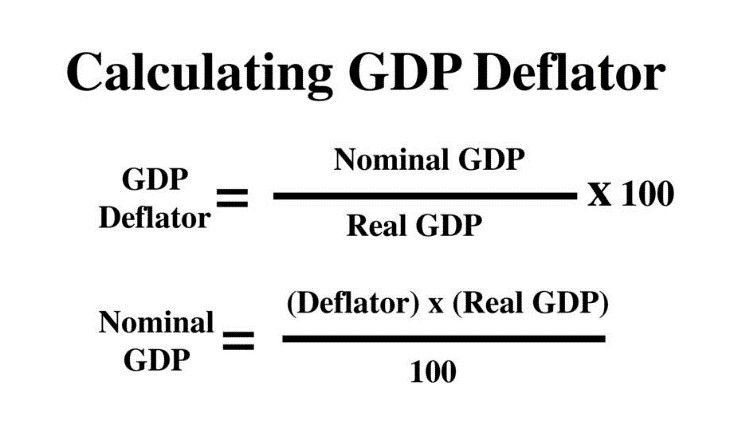
The GDP Deflator tracks price changes in a country’s economy over time. It will take a base year, where nominal GDP equals real GDP, and sets it equal to 100. Any change in price will be reflected in nominal GDP, which will lead to a change in the GDP Deflator.
For example, if the GDP Deflator is 112 the year after the base year, then it indicates that the average price of the output increased by 12%.
Example
Let’s say a country only produces one type of good – it follows the yearly schedule below for both quantity and price.
| Quantity | Price | Nominal GDP | |||
| Year 1 | 100 | x | $10 | = | $1,000 |
| Year 2 | 110 | x | $12 | = | $1,320 |
| Year 3 | 112 | x | $14 | = | $1,568 |
| Year 4 | 108 | x | $13 | = | $1,404 |
| Year 5 | 150 | x | $15 | = | $2,250 |
The information above tells us that between Year 1 and Year 5, GDP could’ve increased because of prices (prevailing inflation) or the quantity output. Further analysis would be required to derive the root cause of the GDP increase.
More Resources
Financial Analyst Certification

Become a certified Financial Modeling and Valuation Analyst (FMVA)® Become a Certified Financial Modeling & Valuation Analyst (FMVA)® CFI’s Financial Modeling and Valuation Analyst (FMVA)® certification will help you gain the confidence you need in your finance career. Enroll today! by completing CFI’s online financial modeling classes!
Nominal and Real GDP, GDP Price Index, GDP Deflator
A primary benefit of measuring the Gross Domestic Product (GDP ) is that it can show the growth of the economy over time, or its lack thereof. However, GDP as measured by current prices does not measure the growth of real GDP, since prices depend on the money supply, which varies independently of GDP from year to year. Nominal GDP is the GDP measured by actual prices, which are unadjusted for inflation. Real GDP measures output in constant dollars, so that the economic output of one year can be accurately compared to another year. Since prices change from year to year, GDP would change from year to year even if the real GDP did not change. Hence, there must be some adjustment in GDP to reflect the change in prices. Rising prices inflate GDP while falling prices deflate GDP. Therefore, to obtain real GDP, the operation must be reversed. Since prices usually rise, GDP is deflated by the amount of the inflation to arrive at real GDP. Hence, it is often called the GDP deflator.
GDP Deflator = 100 × Nominal GDP / Real GDP
Real GDP is simply the nominal GDP deflated by the price index:
Real GDP = Nominal GDP / (GDP Deflator/100)
The Bureau of Economic Analysis (BEA ), along with the Bureau of Labor Statistics (BLS ), compiles the GDP accounts. BEA is an agency of the United States Department of Commerce that produces and distributes economic statistics about governments, businesses, households, and individuals. The most important of these statistics is the National Economic Accounts, which provides statistics on the production, distribution, and the use of economic output, of which the GDP is the most prominent. Most of the information for calculating the GDP accounts for consumption and investment comes from the United States Census Bureau. Information about government purchases and government wages and benefits, which is the single largest expenditure by the federal, state, and local governments, comes from the United States Office of Personnel Management. The Census Bureau also provides some of this information. Most of the information on net exports comes from the United States Customs Service. The Bureau of Labor Statistics provides most of the statistics concerning labor, which is the major input to GDP.
To determine the value of the GDP deflator, a GDP price index must be constructed that shows how much prices have changed from year to year for a representative sample of all products and services. The relative weights of various goods and services in the GDP price index are adjusted annually, unlike the CPI, which is a fixed weight price index for a market basket whose composition is only updated occasionally by the BLS.
A price index measures how much prices have changed in any given year compared to a base year:
| Price of Representative Market Basket in Specific Year | |||
| Price Index in a Given Year | = | × | 100 |
| Price of Representative Market Basket in Base Year |
The multiplication by 100 gives a nice round number, especially for reporting. However, to determine real GDP, the nominal GDP is divided by the price index divided by 100.
To simplify comparisons, the value of the price index is set at 100 for the base year. Previous to the base year, prices were generally lower, so those GDP values must be inflated to compare them to the base year. When prices are less in any given year than they were in the base year, then the price index will be less than 100, so that when real GDP is calculated by dividing the nominal GDP by the price index, it will exceed the nominal GDP. Real GDP = nominal GDP for the base year.
Of course, there are many complexities to calculating real GDP by either method. Statisticians must necessarily use assumptions about the proportion of each type of goods and services purchased during a given year. If you would like to dive into the details of calculating this chain-type annual-weights price index, be my guest: Box: Basic Formulas for Calculating Chain-Type Quantity and Price Indexes.
Potential GDP and the Output Gap
One factor the Federal Reserve considers when deciding on monetary policy is whether the economy is producing its potential output. Potential output, estimated periodically by the Congressional Budget Office (CBO), is an estimate of what an economy could feasibly produce when fully employing its available economic resources. Hence, potential output is the same as potential GDP and is often described as the maximum sustainable output. Sustainable output means that the economy is functioning normally rather than maximally. So, for instance, employees are working regular hours, not overtime, and factories and other sources of production are producing quantities for which they were optimized. Hence, positive output gaps are possible, where the actual output exceeds potential output, since the economy can utilize its resources at higher levels for short periods of time. However, negative output gaps are far more common. A negative output gap indicates that the economy is under utilizing its resources, which often means that the economy is operating at less than full employment. Negative output gaps occur during recessions and positive output gaps occur during economic booms; thus, the output gap mirrors the business cycle of booms and busts.
| Actual Output − Potential Output | |||
| Output Gap | = | × | 100 |
| Potential Output |
If the output gap is negative, then the Federal Reserve will adjust its monetary policy to stimulate the economy more; if positive, then the Federal Reserve would probably increase the federal funds rate to cool the economy.