Ошибка при npm install?
npm ERR! code ELIFECYCLE
npm ERR! errno 1
npm ERR! node-sass@3.13.1 postinstall: `node scripts/build.js`
npm ERR! Exit status 1
npm ERR!
npm ERR! Failed at the node-sass@3.13.1 postinstall script.
npm ERR! This is probably not a problem with npm. There is likely additional logging output above.
npm ERR! A complete log of this run can be found in:
npm ERR! C:\Users\tokihita\AppData\Roaming\npm-cache\_logs\2021-03-04T08_35_37_294Z-debug.log
Простой 1 комментарий

C:\OSPanel\domains\test-zaordu>npm start
> gulp-pug-sass-starter@1.0.0 start C:\OSPanel\domains\test-zaordu
> gulp
gulp[10052]: c:\ws\src\node_contextify.cc:676: Assertion `args[1]->IsString()’ failed.
1: 00007FF72B2A052F napi_wrap+109311
2: 00007FF72B245256 v8::internal::OrderedHashTable::NumberOfElementsOffset+33302
3: 00007FF72B2455D1 v8::internal::OrderedHashTable::NumberOfElementsOffset+34193
4: 00007FF72B252727 node::OnFatalError+51239
5: 00007FF72BABE85F v8::internal::Builtins::builtin_handle+321471
6: 00007FF72BABDA8C v8::internal::Builtins::builtin_handle+317932
7: 00007FF72BABE0D2 v8::internal::Builtins::builtin_handle+319538
8: 00007FF72BABDF33 v8::internal::Builtins::builtin_handle+319123
9: 00007FF72BB9A0CD v8::internal::SetupIsolateDelegate::SetupHeap+464173
10: 00007FF72BB2E8B1 v8::internal::SetupIsolateDelegate::SetupHeap+23825
11: 00007FF72BC18473 v8::internal::SetupIsolateDelegate::SetupHeap+981203
12: 00007FF72BB329D2 v8::internal::SetupIsolateDelegate::SetupHeap+40498
13: 00007FF72BB329D2 v8::internal::SetupIsolateDelegate::SetupHeap+40498
14: 00007FF72BB329D2 v8::internal::SetupIsolateDelegate::SetupHeap+40498
15: 00007FF72BB329D2 v8::internal::SetupIsolateDelegate::SetupHeap+40498
16: 00007FF72BB329D2 v8::internal::SetupIsolateDelegate::SetupHeap+40498
17: 00007FF72BB329D2 v8::internal::SetupIsolateDelegate::SetupHeap+40498
18: 00007FF72BB329D2 v8::internal::SetupIsolateDelegate::SetupHeap+40498
19: 00007FF72BB329D2 v8::internal::SetupIsolateDelegate::SetupHeap+40498
20: 00007FF72BB329D2 v8::internal::SetupIsolateDelegate::SetupHeap+40498
21: 00007FF72BB329D2 v8::internal::SetupIsolateDelegate::SetupHeap+40498
22: 00007FF72BB329D2 v8::internal::SetupIsolateDelegate::SetupHeap+40498
23: 00007FF72BB329D2 v8::internal::SetupIsolateDelegate::SetupHeap+40498
24: 00007FF72BB329D2 v8::internal::SetupIsolateDelegate::SetupHeap+40498
25: 00007FF72BB329D2 v8::internal::SetupIsolateDelegate::SetupHeap+40498
26: 00007FF72BB329D2 v8::internal::SetupIsolateDelegate::SetupHeap+40498
27: 00007FF72BB329D2 v8::internal::SetupIsolateDelegate::SetupHeap+40498
28: 00007FF72BB329D2 v8::internal::SetupIsolateDelegate::SetupHeap+40498
29: 00007FF72BB329D2 v8::internal::SetupIsolateDelegate::SetupHeap+40498
30: 00007FF72BB329D2 v8::internal::SetupIsolateDelegate::SetupHeap+40498
31: 00007FF72BB329D2 v8::internal::SetupIsolateDelegate::SetupHeap+40498
32: 00007FF72BB329D2 v8::internal::SetupIsolateDelegate::SetupHeap+40498
33: 00007FF72BB329D2 v8::internal::SetupIsolateDelegate::SetupHeap+40498
34: 00007FF72BB329D2 v8::internal::SetupIsolateDelegate::SetupHeap+40498
35: 00007FF72BB329D2 v8::internal::SetupIsolateDelegate::SetupHeap+40498
36: 00007FF72BB329D2 v8::internal::SetupIsolateDelegate::SetupHeap+40498
37: 00007FF72BB329D2 v8::internal::SetupIsolateDelegate::SetupHeap+40498
38: 00007FF72BB329D2 v8::internal::SetupIsolateDelegate::SetupHeap+40498
39: 00007FF72BB329D2 v8::internal::SetupIsolateDelegate::SetupHeap+40498
40: 00007FF72BB329D2 v8::internal::SetupIsolateDelegate::SetupHeap+40498
41: 00007FF72BB329D2 v8::internal::SetupIsolateDelegate::SetupHeap+40498
42: 00007FF72BB329D2 v8::internal::SetupIsolateDelegate::SetupHeap+40498
43: 00007FF72BB329D2 v8::internal::SetupIsolateDelegate::SetupHeap+40498
44: 00007FF72BB329D2 v8::internal::SetupIsolateDelegate::SetupHeap+40498
45: 00007FF72BB329D2 v8::internal::SetupIsolateDelegate::SetupHeap+40498
46: 00007FF72BB329D2 v8::internal::SetupIsolateDelegate::SetupHeap+40498
47: 00007FF72BB329D2 v8::internal::SetupIsolateDelegate::SetupHeap+40498
48: 00007FF72BB329D2 v8::internal::SetupIsolateDelegate::SetupHeap+40498
49: 00007FF72BB329D2 v8::internal::SetupIsolateDelegate::SetupHeap+40498
50: 00007FF72BB329D2 v8::internal::SetupIsolateDelegate::SetupHeap+40498
51: 00007FF72BB329D2 v8::internal::SetupIsolateDelegate::SetupHeap+40498
52: 00007FF72BB329D2 v8::internal::SetupIsolateDelegate::SetupHeap+40498
53: 00007FF72BB329D2 v8::internal::SetupIsolateDelegate::SetupHeap+40498
54: 00007FF72BB329D2 v8::internal::SetupIsolateDelegate::SetupHeap+40498
55: 00007FF72BB329D2 v8::internal::SetupIsolateDelegate::SetupHeap+40498
56: 00007FF72BB329D2 v8::internal::SetupIsolateDelegate::SetupHeap+40498
57: 00007FF72BB329D2 v8::internal::SetupIsolateDelegate::SetupHeap+40498
58: 00007FF72BB329D2 v8::internal::SetupIsolateDelegate::SetupHeap+40498
59: 00007FF72BB329D2 v8::internal::SetupIsolateDelegate::SetupHeap+40498
60: 00007FF72BB329D2 v8::internal::SetupIsolateDelegate::SetupHeap+40498
61: 00007FF72BB329D2 v8::internal::SetupIsolateDelegate::SetupHeap+40498
62: 00007FF72BB329D2 v8::internal::SetupIsolateDelegate::SetupHeap+40498
63: 00007FF72BB329D2 v8::internal::SetupIsolateDelegate::SetupHeap+40498
64: 00007FF72BB329D2 v8::internal::SetupIsolateDelegate::SetupHeap+40498
65: 00007FF72BB329D2 v8::internal::SetupIsolateDelegate::SetupHeap+40498
66: 00007FF72BB329D2 v8::internal::SetupIsolateDelegate::SetupHeap+40498
67: 00007FF72BB329D2 v8::internal::SetupIsolateDelegate::SetupHeap+40498
68: 00007FF72BB329D2 v8::internal::SetupIsolateDelegate::SetupHeap+40498
69: 00007FF72BB329D2 v8::internal::SetupIsolateDelegate::SetupHeap+40498
70: 00007FF72BB329D2 v8::internal::SetupIsolateDelegate::SetupHeap+40498
71: 00007FF72BB329D2 v8::internal::SetupIsolateDelegate::SetupHeap+40498
72: 00007FF72BB329D2 v8::internal::SetupIsolateDelegate::SetupHeap+40498
73: 00007FF72BB2C609 v8::internal::SetupIsolateDelegate::SetupHeap+14953
74: 00007FF72BB329D2 v8::internal::SetupIsolateDelegate::SetupHeap+40498
75: 00007FF72BB329D2 v8::internal::SetupIsolateDelegate::SetupHeap+40498
76: 00007FF72BB329D2 v8::internal::SetupIsolateDelegate::SetupHeap+40498
77: 00007FF72BB329D2 v8::internal::SetupIsolateDelegate::SetupHeap+40498
78: 00007FF72BB329D2 v8::internal::SetupIsolateDelegate::SetupHeap+40498
79: 00007FF72BB329D2 v8::internal::SetupIsolateDelegate::SetupHeap+40498
80: 00007FF72BB329D2 v8::internal::SetupIsolateDelegate::SetupHeap+40498
81: 00007FF72BB329D2 v8::internal::SetupIsolateDelegate::SetupHeap+40498
82: 00007FF72BB3068E v8::internal::SetupIsolateDelegate::SetupHeap+31470
83: 00007FF72BB3027C v8::internal::SetupIsolateDelegate::SetupHeap+30428
84: 00007FF72BA00761 v8::internal::Execution::CallWasm+1649
85: 00007FF72B9FFFCF v8::internal::Execution::Call+191
86: 00007FF72BAEB917 v8::Function::Call+615
87: 00007FF72B2C427D node::CallbackScope::
CallbackScope+861
88: 00007FF72B2C45BB node::CallbackScope::
Peer dependency warning #439
Comments
mromarreyes commented Feb 8, 2018
When installing the package I get the following error:
npm WARN react-native-fs@2.9.10 requires a peer of react-native@^0.51.0 but none is installed. You must install peer dependencies yourself.
npm WARN react-native-fs@2.9.10 requires a peer of prop-types@15.6.0 but none is installed. You must install peer dependencies yourself.
npm WARN react-native-fs@2.9.10 requires a peer of create-react-class@^15.6.2 but none is installed. You must install peer dependencies yourself.
I’m running:
«react»: «16.2.0»,
«react-native»: «0.52.2»,
The text was updated successfully, but these errors were encountered:
sbordov commented Feb 13, 2018
I’m having the same issue. If I downgrade to react-native@^0.51.0, I then get the following error:
npm WARN react-native@0.51.0 requires a peer of react@16.0.0 but none was installed.
If I downgrade react from 16.2.0 to 16.0.0, I get this lovely error:
npm WARN react-native-fs@2.9.10 requires a peer of react@^16.2.0 but none was installed.
Any help with this issue would be greatly appreciated.
itinance commented Feb 13, 2018 •
Don’t worry! These are just WARNINGS, no Errors! Similar warnings appear on «react-native init testApp». It has something to do with required versions in package.json and we need another approach here towards RN upgrades. But nothing will break here.
no23reason commented Mar 13, 2018
@itinance I agree, they are only warnings, however the create-react-class peerDependecy is imo unnecessary, as this package is used only in tests – it should only be a devDependecy (it already is).
itinance commented Mar 13, 2018
@no23reason please feel always free to send a PR 🙂
no23reason commented Mar 13, 2018
aMarCruz commented Mar 18, 2018 •
Getting the dependencies right
Motivation
Modules and models are typically interconnected by a network of dependencies of various types. Assuming you have understood the basic principles and categorisations of modules and models, as described at the MPS project structure page, we can now dive deeper as learn all the details.
Getting dependencies right in MPS is a frequent cause of frustration among inexperienced users as well as seasoned veterans. This page aims to solve the problem once and for all. You should be able to find all the relevant information categorised into sections by the various module and dependency types.
In addtion, since MPS is a multi-language development environment, models can specify the languages (aka syntaxes) enabled in them. This is different from when writing code in Java, Ruby or other languages, where the language to be used is given and fixed by conventions (e.g. the file extension).
Useful keyboard shortcuts
Whenever positioned on a model or a node in the left-hand-side Project Tool Window or when editing in the editor, you can invoke quick actions with the keyboard that will add dependencies or used languages into the current model as well as its containing solution.
Solution
Solutions represent programs written in one or more languages. They typically serve two purposes:
We’ll start with the properties valid for all solutions and then cover the specifics of runtime and plugin solutions.
Common
Properties
Model root types
Solutions contain model roots, which in turn contain models. Each model root typically points to a folder and the contained models lie in one or more sub-folders of that folder. Depending on the type of contained models, the model roots are of different kinds:
default— the standard MPS model root type holding MPS models
java_classes— a set of directories or jar files containing Java class files
javasource_stubs— a set of directories or jar files containing Java sources
When included in the project as models, Java classes in directories or jar files will become first-class citizens of the MPS model pool and will become available for direct references from other models, which import these stub models. A second option to include classes and jars in MPS is to use the Java tab and define them as libraries. In that case the classes will be loaded, but not directly referenceble from MPS code. This is useful for libraries that are needed by the stub models.
Dependencies
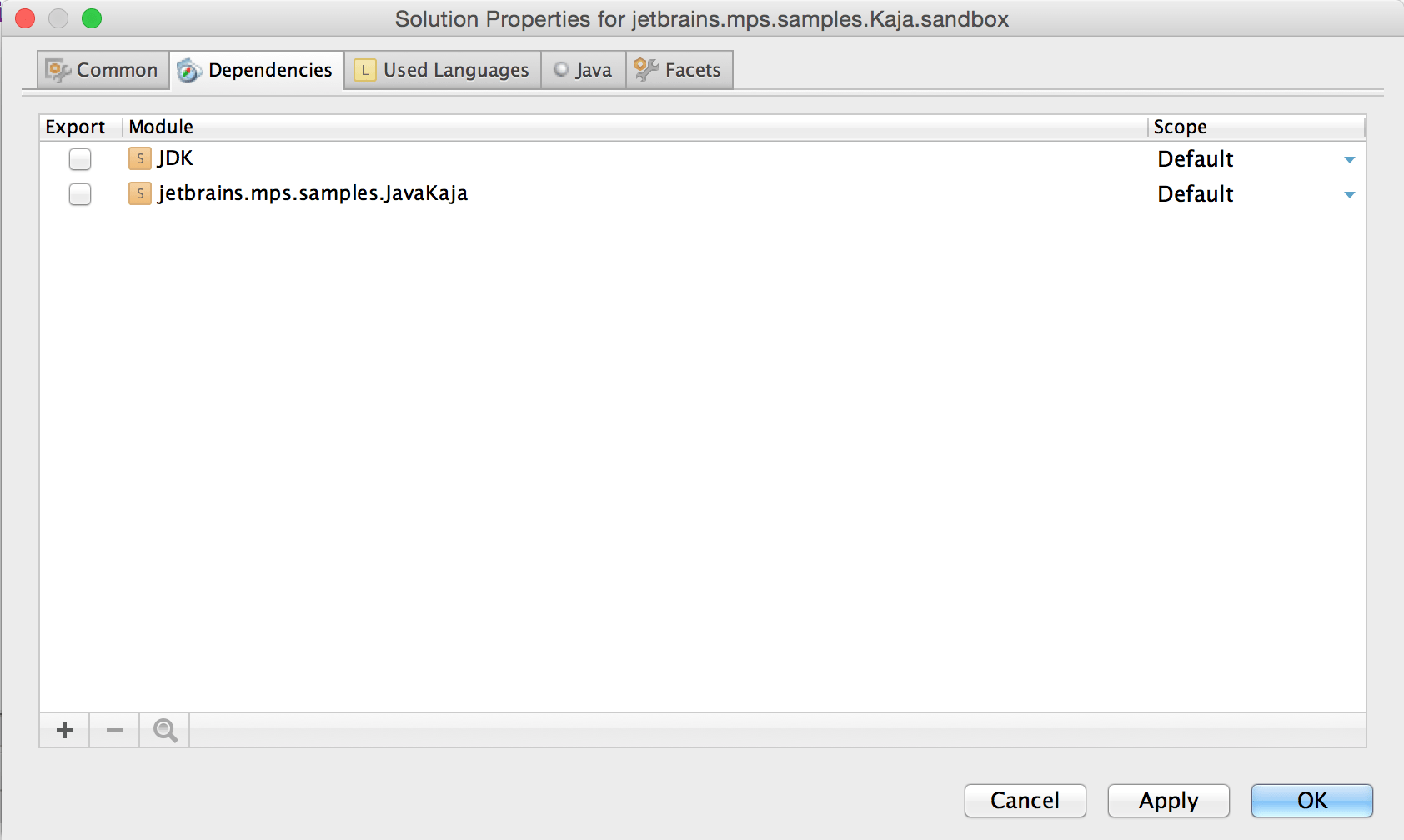
The dependencies of a solutions are other solutions and languages, the models of which will be visible from within this solution.
The Export flag then specifies whether the dependency should be transitively added as a dependency to all modules that depend on the current solution. For example, of module A depends on B with export on and C depends on A, then C depends on B.
Used Languages
The languages as well as devkits that the solution’s models may use are listed among used languages. Used languages are specified on the model level and the Used Languages tab on modules only shows a collection of used languages of its all models.
This is where the different kinds of Solutions differ mostly.
The Java tab contains several options:
Editor plugin used by code that ties into the MPS editor and needs to have its class-loading managed in sync with the rest of the editor- use for Plugin solutions that only enhance the editor
Facets
Solution models
Solutions contain one or more models. Models can be mutually nested and form hierarchies, just like, for example, Java packages can. The properties dialog hides a few configuration options that can be tweaked: 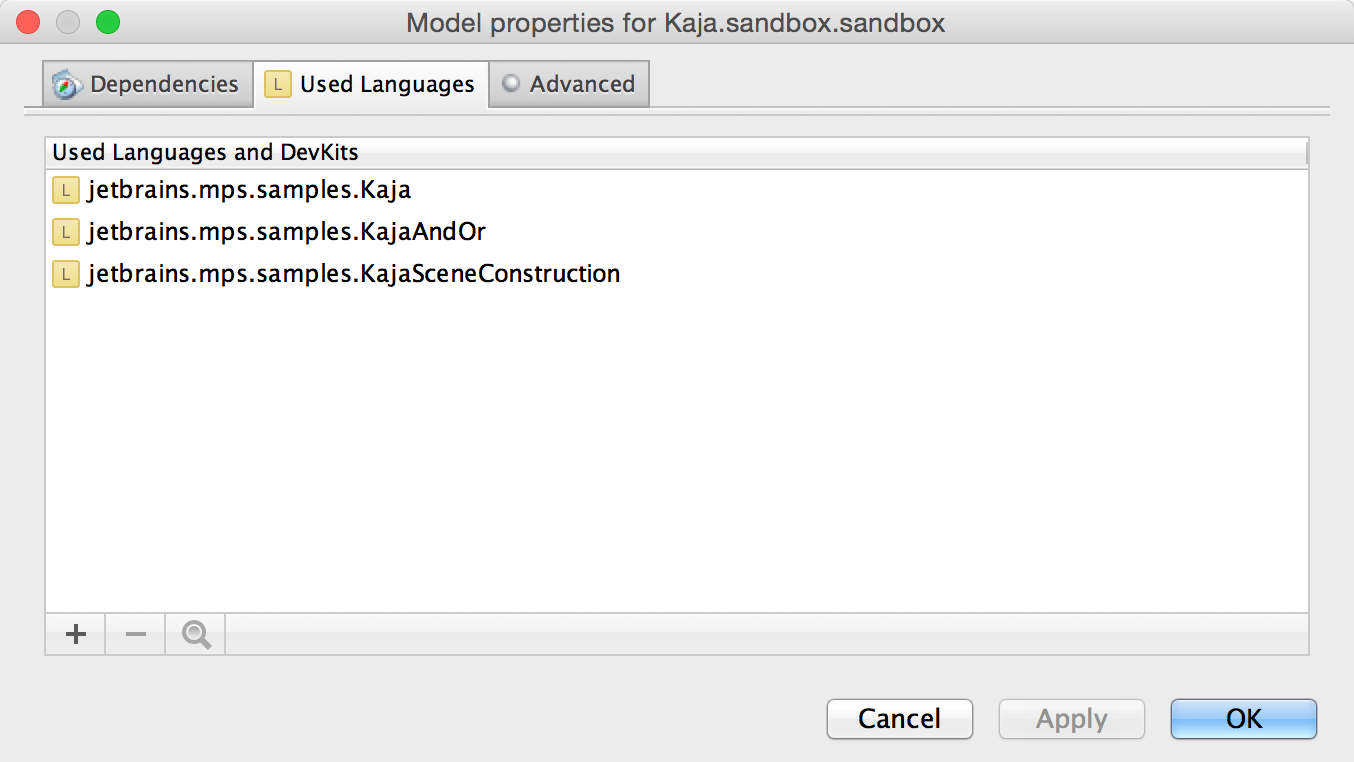
Dependencies
Models from the current or imported modules can be listed here, so that their elements become accessible in code of this model.
Used languages
The languages used by this model must be listed here.
Advanced
A few extra options are listed on the Advanced tab:
Virtual packages
Nodes in models can be logically organised into hierarchies of virtual packages. Use the Set Virtual Package option from the node’s context pop-up menu and specify a name, possibly separating nested virtual folder names with the dot symbol.
Runtime solutions represent libraries of reusable code in MPS. They may contain models holding MPS code as well as stub models that refer to external Java sources, classes or jar files. To properly include external Java code in a project, you need to follow a few steps:
Create a new Solution in your project.
Copy the desired jar files, classes or Java sources into a directory under the solution’s root folder, such as «/libs».
In the Solution’s properties dialog ( Alt+Enter ) attach the Java code. This requires a few steps:
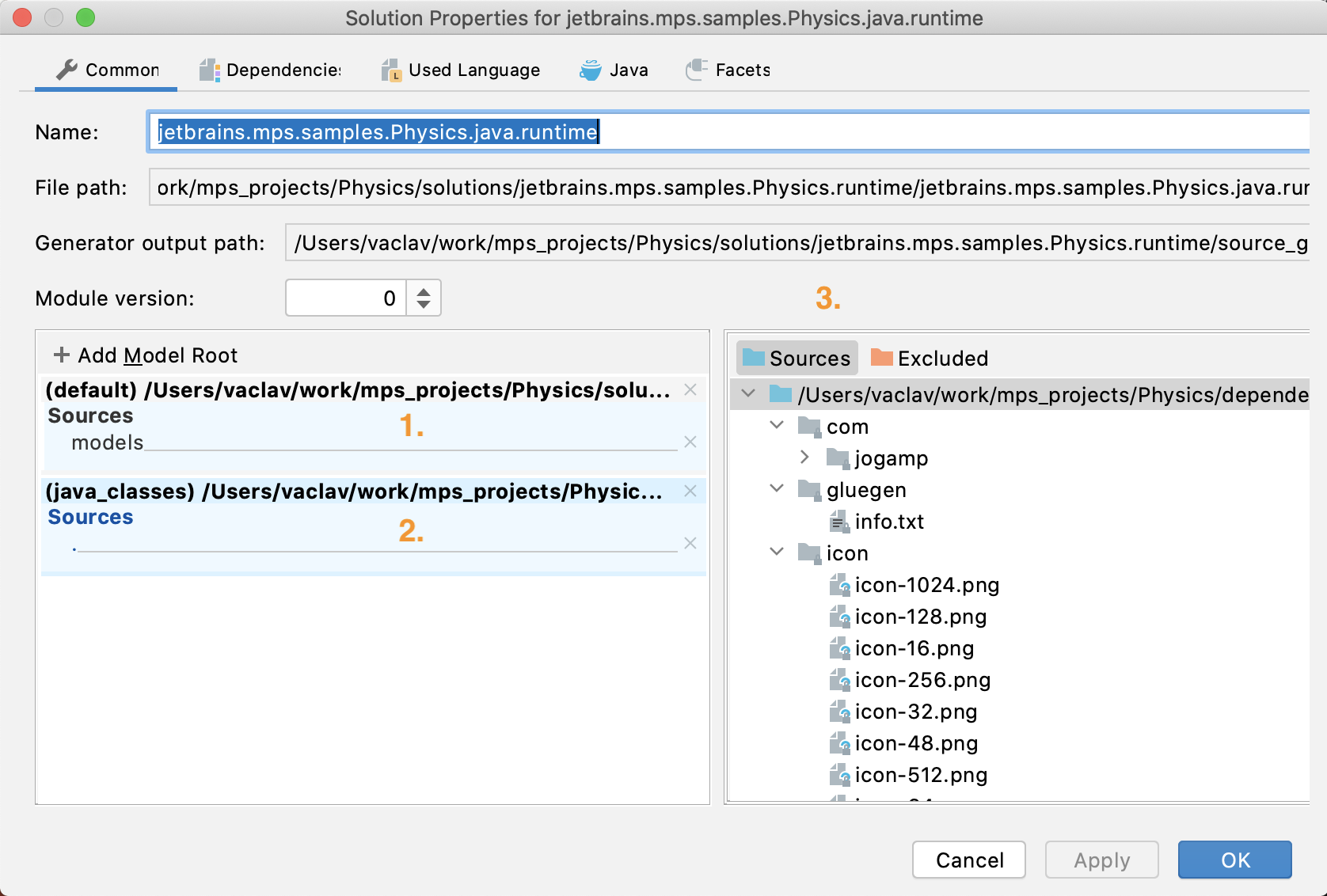
First, in the left-hand side panel of the Common tab, which is used to manage model roots (i.e. locations of models that belong to the module), delete the existing model root unless you want to preserve or create code that you write in MPS as part of your runtime library.
Second, also in the Common tab, click on Add Model Root, select javaclasses for classes or jars, select javasource_stubs for Java sources and navigate MPS to your lib folder. This will add a new entry into the list of model roots. This entry will represent the «libs» folder
Third, when the new model root is selected in the left-hand side panel, select the folder(s) or jar(s) listed in the right-side panel of the properties dialog and click on the blue «Models» button at the top of the right-hand side panel. The selected folders and jars will be shown with a blue icon next to them in the right-hand side panel.
Switch to the Dependencies tab and add the JDK solution as a dependency. Do not forget to turn on the Export flag. This will allow your jar files to refer to the JDK classes. 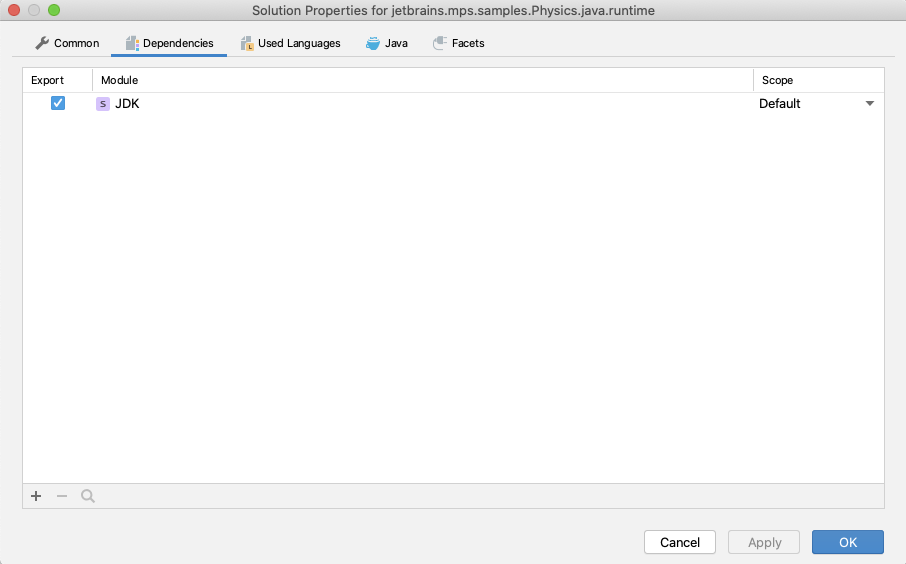
Then head to the Java tab to add all the jars or the classes root folders to the Libraries part of the window, otherwise the solution using the library classes would not be able to compile. When using java_sourcestubs, add the sources into the Source paths part of the Java tab window, instead. Also add any dependencies of the libraries that you have added to the module. 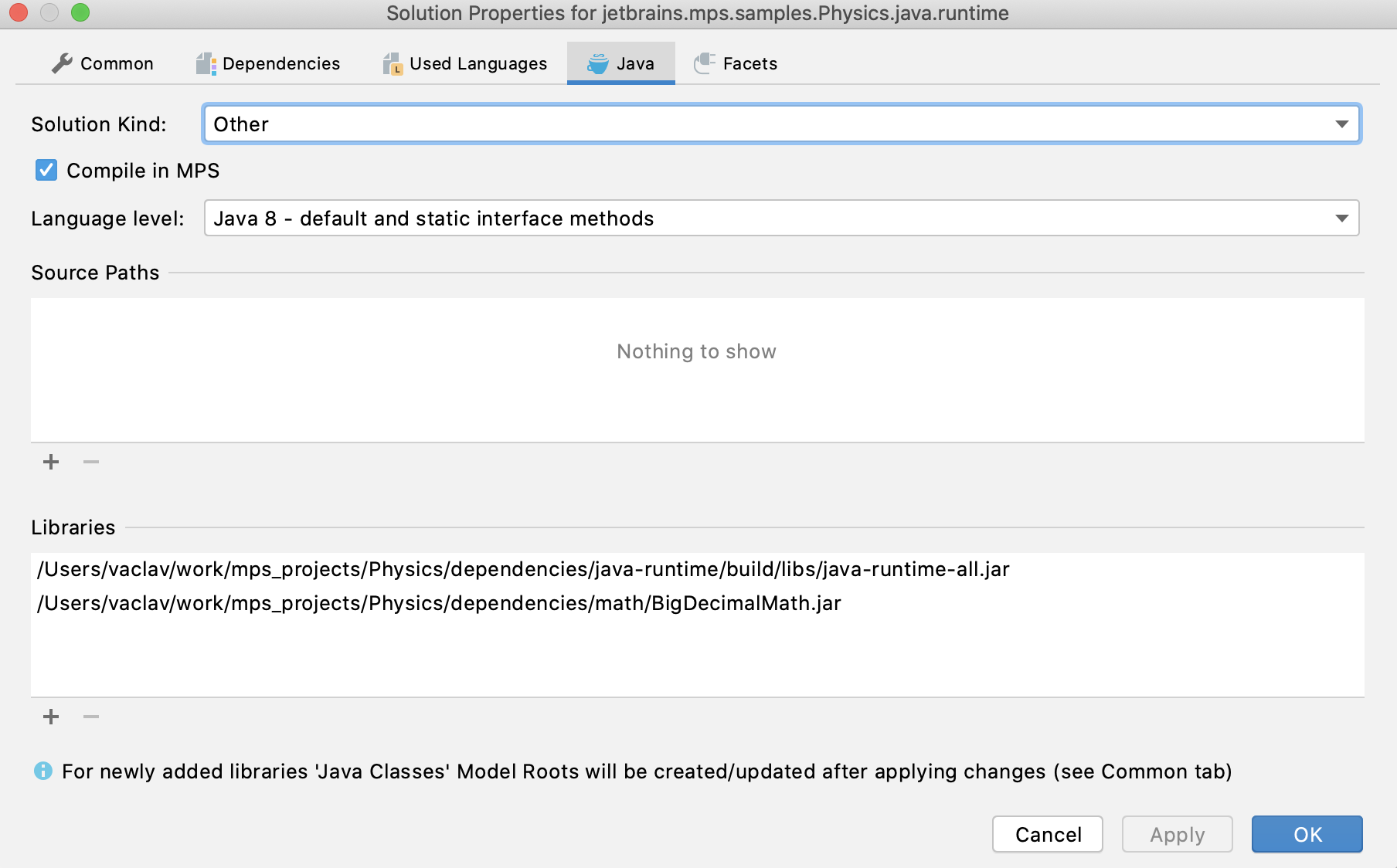
Although the paths shown in the dialog appear to be absolute, MPS stores paths relative to the project root (provided they refer to locations under the project root directory), so the path adjust automatically to the MPS environment that opens your project.
Additionally, set Solution Kind to Other to have MPS reload the classes properly.
A new folder named stubs should appear in your solution 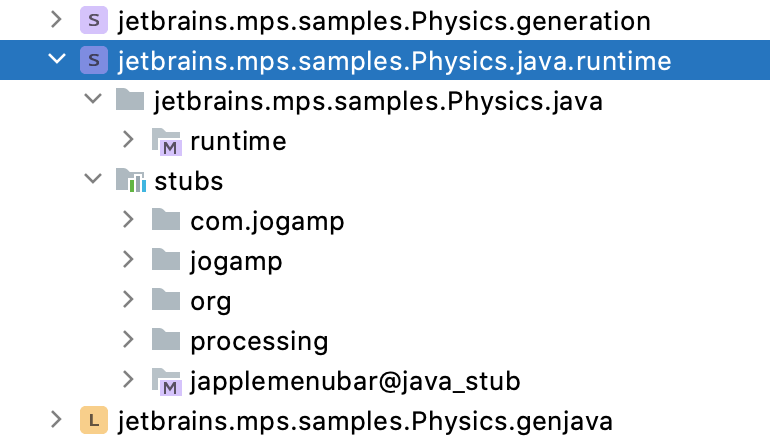 .
.
Now after you import the solution into another module (solution, language, generator) the classes will become available in that module’s models.
The languages that want to use the runtime solution as a runtime dependency of the code that gets generated by the language’s generator will need to refer to it in the Runtime Solutions section of the Runtime tab of their module properties. 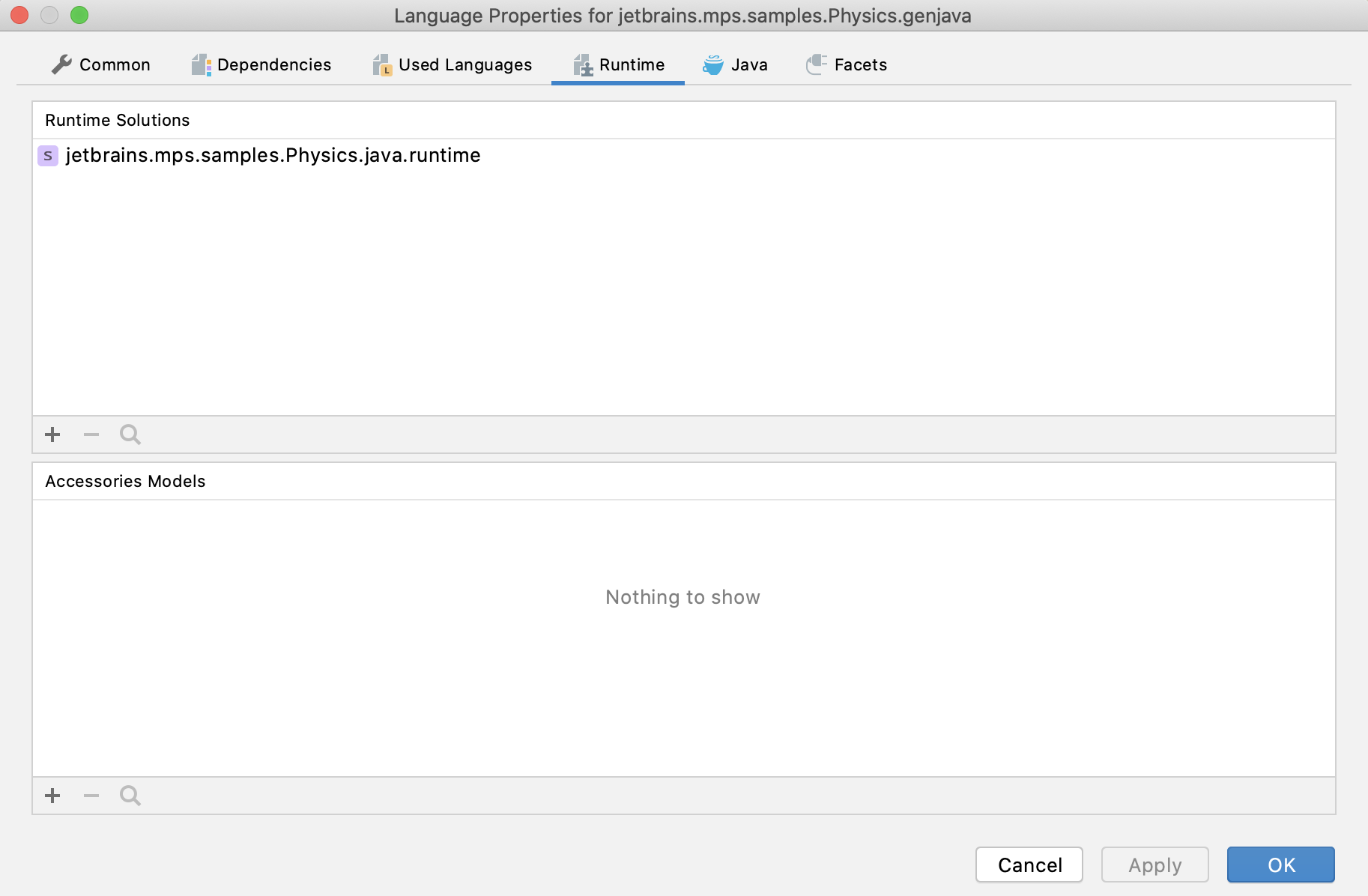
If you forget to do so, you’ll be getting errors like «No such path in local layout» when rebuilding the build script’s model.
Language
Languages represent a language definition and consist of several models, each of which represent a distinct aspect of the language. Languages also contain a single Generator module. The properties dialog for languages is in many ways similar to the one of Solutions. Below we will only mention the differences: 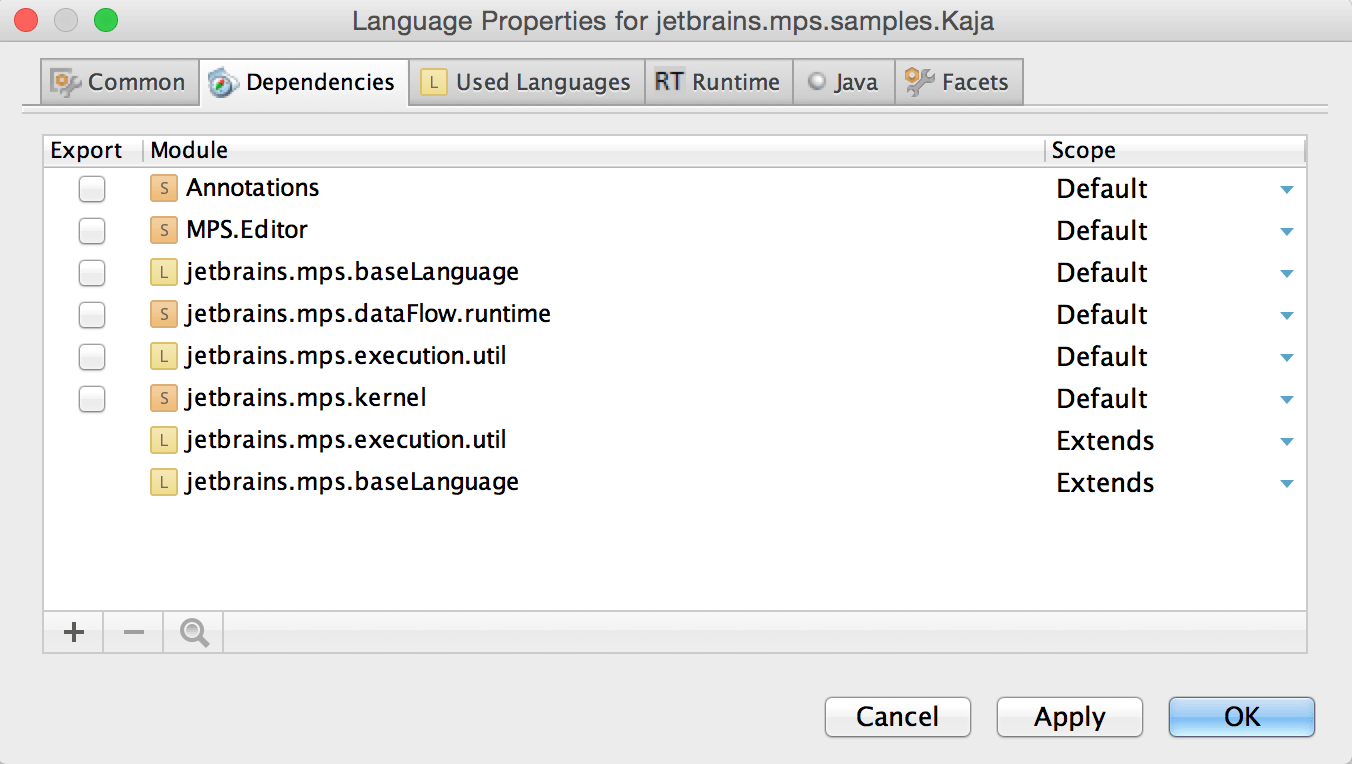
Common
A language typically has a single model root that points to a directory, in which all the models for the distinct aspects are located.
Dependencies
The dependencies of a language are other solutions and languages, the models of which will be visible from within this solution. The Export flag then specifies whether the dependency should be transitively added as a dependency to all modules that depend on the current language.
A dependency on a language offers thee Scope options:
Default— only makes the models of the other language/solution available for references (aggregation)
The structure aspects manifest languages they incorporate by aggregation (i.e. using a foreign concept in a child role), there’s no need to import such languages explicitly into a model that uses the aggregating language or to ‘extend’ language modules.
Used Languages
This is the same as for solutions.
Runtime
This is the same as for solutions, except for the two missing options that are not applicable to languages.
Facets
This is the same as for solutions.
When using a runtime solution in a language, you need to set both the dependency in the Dependencies tab and the Runtime Solutions on the Runtime tab.
Language models/aspects
Dependencies / Used Languages / Advanced
These settings are the same and have the same meaning as the settings on any other models, as described in the Solution section.
Generator
The generator module settings are very similar to those of other module types:
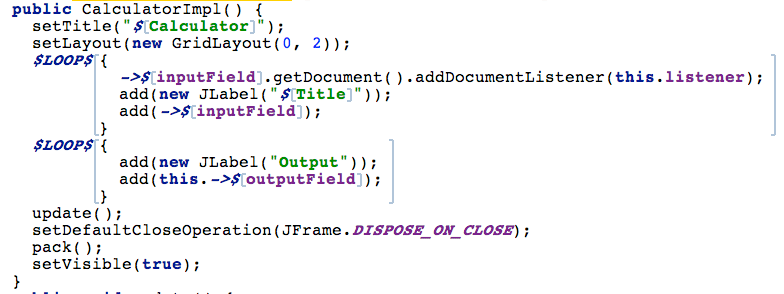
Common
This is the same as for languages.
Dependencies
This is the same as for solutions. Additionally generator modules may depend on other generator modules and specify Scope:
Used Languages
This is the same as for languages.
Generators priorities
This tab allows to define priority rules for generators, in order to properly order the generators in the generation process. Additionally, three options are configurable through the check-boxes at the bottom of the dialog: