longitude and latitude
Смотреть что такое «longitude and latitude» в других словарях:
latitude — lat‧i‧tude [ˈlættjuːd ǁ tuːd] noun [uncountable] JOURNALISM freedom to choose what you do or say: latitude in • The new guidelines give banks more latitude in making loans. • States generally have wide latitude in setting tax policies. * * *… … Financial and business terms
Longitude — For Dava Sobel s book about John Harrison, see Longitude (book). For the adaptation of Sobel s book, see Longitude (TV series). Map of Earth Longitude (λ) Lines of longitude appear vertical with varying curvature in this projection, but are… … Wikipedia
Latitude — This article is about the geographical reference system. For other uses, see Latitude (disambiguation). Map of Earth Longitude (λ) Lines of longitude appear vertical with varying curvature in this projection, but are actually halves of great… … Wikipedia
latitude and longitude — Coordinate system by which the position or location of any place on the Earth s surface can be determined and described. Latitude is a measurement of location north or south of the Equator. Lines of latitude are known as parallels, or parallels… … Universalium
longitude — [län′jə to͞od΄, län′jətyo͞od΄; lôn′jə to͞od΄, lôn′jə tyo͞od΄] n. [ME < L longitudo < longus, LONG1] 1. length 2. distance east or west on the earth s surface, measured as an arc of the equator (in degrees up to 180° or by the difference in… … English World dictionary
Longitude prize — The Longitude Prize was a reward offered by the British government through an Act of Parliament in 1714 for a simple and practical method for the precise determination of a ship s longitude. The prize was administered by the Board of… … Wikipedia
Latitude and longitude of cities — See:*Latitude and longitude of cities, A H *Latitude and longitude of cities, I P *Latitude and longitude of cities, Q Z … Wikipedia
Latitude and longitude of cities, A-H — ee also*Latitude and longitude of cities, I P *Latitude and longitude of cities, Q Z … Wikipedia
Latitude and longitude of cities, I-P — ee also*Latitude and longitude of cities, A H *Latitude and longitude of cities, Q Z … Wikipedia
Latitude and longitude of cities, Q-Z — ee also*Latitude and longitude of cities, A H *Latitude and longitude of cities, I P … Wikipedia
What Are Longitudes and Latitudes?
Cartographers and geographers trace horizontal and vertical lines called latitudes and longitudes across Earth’s surface to locate points on the globe.
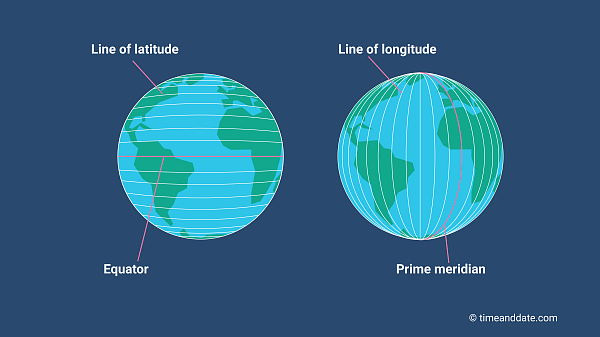
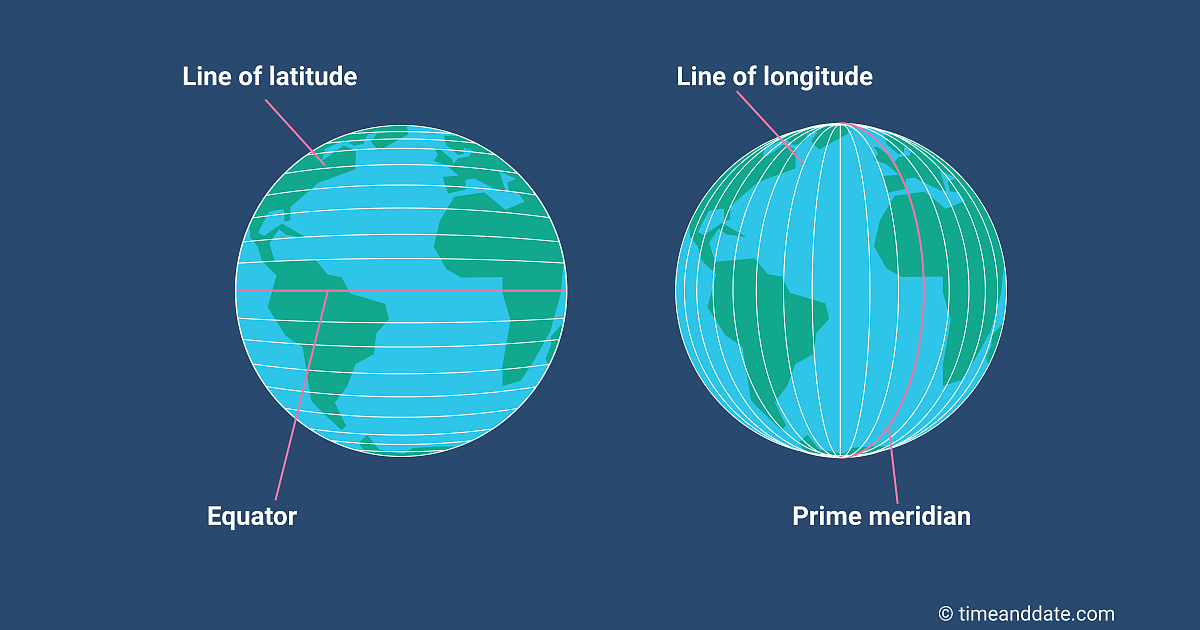
Longitudes and latitudes.
Together, they form the Earth’s geographical coordinates, and represent the angular distance of any location from the center of the Earth. Both latitudes and longitudes are measured in degrees (°) and minutes (′).
Dividing Earth Into Hemispheres
The Earth is, almost, but not quite, a sphere that rotates around its axis. Scientists call this shape a spheroid or ellipsoid. If we draw a line passing through the center of the Earth along its rotational axis, the line would pass through the North and the South Pole.
The Equator is an imaginary line perpendicular to this axis. It is equidistant from the North and South Poles, and divides the globe into the Northern Hemisphere and the Southern Hemisphere.
Most locations on the Equator experience consistently high temperatures throughout the year. They also experience at least 12 hours of daylight every day during the year. On the Equinoxes – September and March – the Sun is directly overhead the Equator, resulting in almost exactly 12 hour days and 12 hour nights.
The Equator passes through 14 countries, including Uganda, Kenya, Somalia, Indonesia, Ecuador, Colombia, and Brazil.
Imaginary Circles
Often called parallels or circles of latitude, latitudes are imaginary circles parallel to the Equator. They are named after the angle created by a line connecting the latitude and the center of the Earth, and the line connecting the Equator and the center of the Earth.
Latitudes specify the north-south position of a location on the globe. Locations in the Northern Hemisphere are identified by northern latitudes and are assigned a suffix of N for north. Southern Hemisphere locations, on the other hand, are on southern latitudes and are assigned a suffix of S for south.
Notable Latitudes
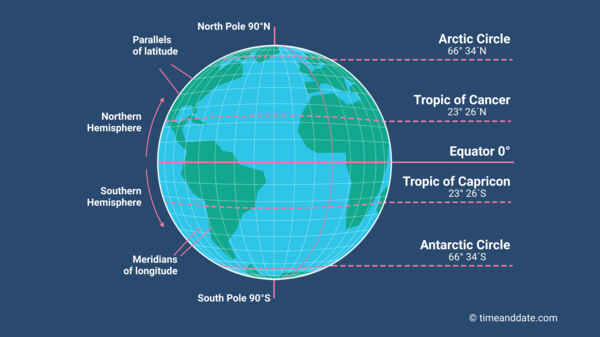
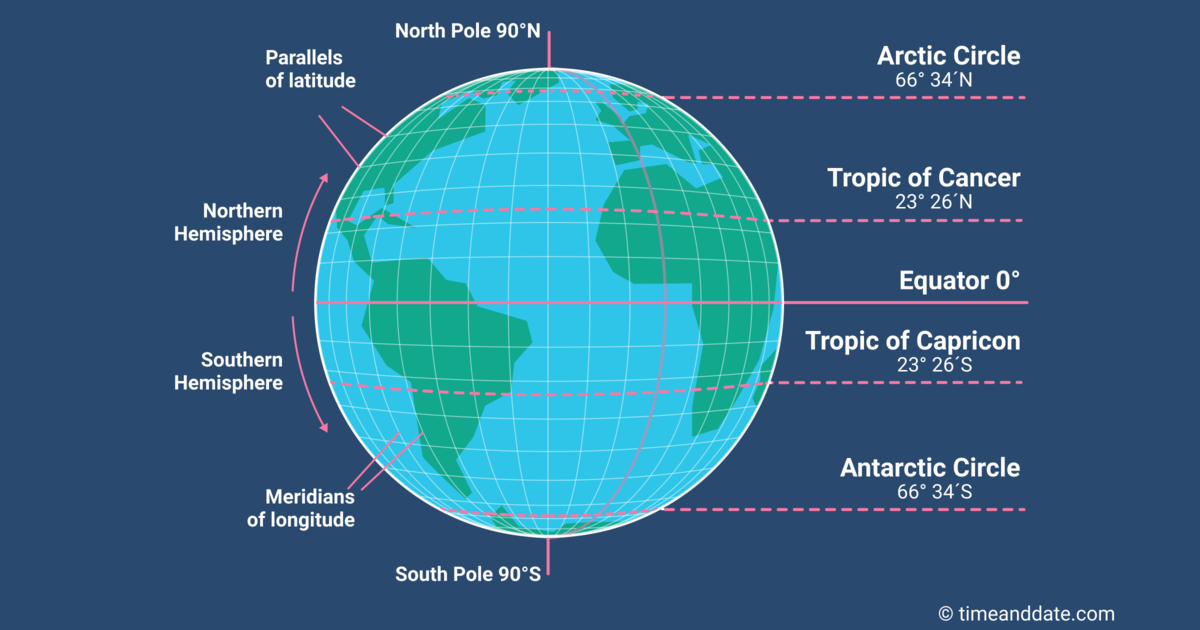
The major latitudes and longitudes.
The Equator represents 0° latitude, while the North and South Poles represent 90° North and 90° South latitudes. In addition to the Equator, there are four other major latitudes that are usually found on maps and globes. The positions of these latitudes are determined by the Earth’s axial tilt.
The latitude 23° 26′ North is also known as the Tropic of Cancer. It marks the northern-most position on the Earth, where the Sun is directly overhead at least once a year. This happens during the June Solstice, when the Earth’s Northern Hemisphere is tilted towards the Sun.
The Tropic of Capricorn is the latitude that lies at 23° 26′ South of the Equator. It is the southern-most position on the globe, where the Sun is directly overhead during the December Solstice.
Sometimes, latitudes north of the Equator are denoted by a positive sign. Latitudes south of the Equator are given negative values. This eliminates the need to add whether the specified latitude is north or south of the Equator.
East-West Locations
Longitudes are geographical positioning markers that run from the geographical North Pole to the geographical South Pole, intersecting the Equator. They meet at both Poles, and specify the east-west position of a location.
Longitudes are, therefore, imaginary circles that intersect the North and South Poles and the Equator. Half of a longitudinal circle is known as a Meridian. Meridians are perpendicular to every latitude.
Unlike, latitudes, there is no obvious central longitude. However, in order to measure the position of a location based on the longitude, cartographers and geographers over the course of history have designated different locations as the main longitudinal reference point. Today, the meridian line through Greenwich, England, is considered as the reference point for longitudes. This line is also known as the Prime Meridian.
The Prime Meridian is set as 0° longitude and it divides the Earth into the Eastern and the Western Hemispheres. All the other longitudes are measured and named after the angle they make with respect to the center of the Earth from the intersection of the Meridian and the Equator.
Since a sphere has 360 degrees, the Earth is divided into 360 longitudes. The meridian opposite the Prime Meridian (on the other side of the Earth) is the 180° longitude and is known as the antimeridian.
Modern timekeeping systems use longitudes as references to keep time. Time zones are defined by the Prime Meridian and the longitudes.
An Easy Way to Remember
One easy way to remember the orientation of latitudes and longitudes is longitudes are long, and latitudes are lateral.
Did You Know?
A Great Circle is any circle that is formed by a plane that passes through the center of the Earth. The Equator and the circles created by the meridians form Great Circles.
The shortest line between two points on the Earth’s surface is always the arc of a Great Circle. Because of this, Great Circles are important for the study of migration and other human interactions and activities, including shipping and airline routes.
Latitude vs. Longitude

The latitude specifies a location’s distance north or south of the equator. The longitude specifies the location’s distance east or west from an imaginary line connecting the North and South Poles, called the Prime Meridian.
Latitude and longitude are used together to specify the geographical coordinates of a location on Earth. Latitudes, represented by the Greek letter phi (Φ), are called parallels and longitudes, denoted by the Greek letter lambda (λ), are called meridians.
Comparison chart
| Latitude | Longitude | |
|---|---|---|
| Direction | East-west, parallel to the equator | North-south; converging at the poles and widest at the equator |
| Parallel lines | Yes | No |
| Range | 0 to 90° North and South | 0 to 180° East and West |
| Denoted by | Greek letter phi (Φ) | Greek letter lambda (λ) |
| Hemisphere | All locations along a common latitude fall in the same hemisphere of the earth (northern or southern) | Locations along a common longitude may be in different hemispheres. |
| Denotes distance from | equator (north or south) | Prime Meridian (east or west) |
| Time zone | Locations that share the same latitude do not necessarily fall into the same time zone | All locations on the same longitude fall in the same time zone |
| Number of lines | 180 | 360 |
| Notable lines | Equator, Tropic of Cancer, Tropic of Capricorn | Greenwich Meridian |
| Applications | Classifying temperature zones | Classifying time zones |


Measurement and Values

Latitude and longitude are both measured in degrees, minutes and seconds. There are 60 minutes in each degree and 60 seconds in each minute.
Values for longitude range from 0 (for the Prime Meridian) to 180 degrees. They are denoted by the letters E or W to represent direction. Alternatively, positive values may be used east of the Prime Meridian and negative in the west.
They range from 0 (for the Equator) to 90 (for the north and south poles). Latitudes are not only parallel but equidistant; degrees of latitudes are all roughly 69 miles apart. Values for latitude are positive in the Northern hemisphere and negative for the Southern hemisphere. Alternatively, the letters N and S may be used to denote the location.
Measuring longitudes and latitudes
The Prime Meridian passes through the Royal Observatory in Greenwich, UK. Meridians are drawn in such a way that at the equator, the angle between the lines connecting both meridians to the center of the earth is one degree.
The latitude of a location is measured by observing the inclination of the sun or the position of known stars in the sky and calculating the angular distance from the horizon to them.
Video
This is an educational video about latitudes and longitudes.
Notable latitudes and longitudes
Besides the equator, four other parallels are of significance [1] :
The region between the Tropic of Cancer and the Tropic of Capricorn is called the tropics. It is a region characterized by hot and humid climate. The sun is directly overhead at noon only in the tropics. The region between the tropics and the Arctic or Antarctic circles is called the Temperate zone and is characterized by four distinct seasons.
During the winter solstice (December), the sun is directly overhead the Tropic of Capricorn and the region south of the Antarctic circle experiences 24 hours of daylight. At the same time, the region north of the Arctic circle experiences 24 hours of night time. The situation is reversed during the summer solstice when the sun is directly overhead the Tropic of Cancer.
The most important longitudes are the Prime Meridian (0°) and the International Date Line (180°). They are at opposite sides of the Earth. The International Date Line marks the place where each day officially begins. So at the International Date Line, the west side of the line is always one day ahead of the east side. This is because the direction of rotation of the Earth is west to east. The Prime Meridian marks the location for the Coordinated Universal Time (UTC) or Greenwich Mean Time (GMT). Other time zones are denoted with offsets (positive or negative) from GMT/UTC.
In everyday life, the longitude for a location can be approximated using the time difference between that location and UTC. The sun moves across the sky at a rate of 15 degrees per hour (360°/day). So if the time zone is three hours ahead of UTC then that location is near 45° longitude (3 hours × 15° per hour = 45°). Longitudes converge at the Poles so calculations that are accurate for other positions may be inaccurate at the Poles.