MonoDevelop
Настройка MonoDevelop
MonoDevelop устанавливается по умолчанию вместе с Unity. Во время установки Unity на Windows, вы можете отменить установку MonoDevelop. Вы должны убедиться, что MonoDevelop установлен в качестве внешнего редактора скриптов в Preferences (меню: Unity > Preferences, а затем выберите панель External Tools). Если эта опция включена, Unity запустит MonoDevelop и будет использовать его в качестве редактора по умолчанию для всех скриптовых файлов.
Настройка отладчика
Чтобы включить отладку исходного кода (см. ниже для подробностей) в MonoDevelop, вам сперва следует проверить, что в Preferences, на панели External Tools включена опция Editor Attaching. Затем, вам следует синхронизировать ваш Unity проект с проектом MonoDevelop (меню: Assets > Sync MonoDevelop Project). Кроме того, убедитесь, что в BuildSettings целевой платформы (меню: File > Build Settings) включены опции Development Build и Script Debugging. Если вы собираете под WebPlayer, тогда вам следует дополнительно убедиться, что в контексте вашего проигрывателя выбран канал версий для разработчиков (правый клик в Windows или cmd-клик в Mac OSX).
Just before starting a debugging session, select the target you wish to debug from the target list next to the play button (Unity Editor, OSX Player, etc.). You can also select “Attach To Process”, this will show the full list of debuggable Unity processes.
 Вкладка, показывающая значения переменных
With these steps completed, you are ready to being debugging your Unity scripts by clicking the play button.
Отладка исходного кода
Текущие открытые исходные файлы отображаются в MonoDevelop в виде вкладок и могут быть отредактированы как в стандартном текстовом редакторе. Также есть серая шкала точек останова (breakpoint bar) слева от панели редактора. Щелчок на этой шкале добавит так называемый маркер точки останова (breakpoint) напротив текущей строчки кода.
 Breakpoint, добавленный в код а строке 16
Добавление breakpoint’а на линию сообщает Unity, что по достижению этой линии во время Play Mode, следует приостановить выполнение скрипта. Когда скрипт так “замораживается”, вы можете использовать отладчик для определения того, что именно делает скрипт.
 Стрелка показывает, что выполнение приостановлено на точке останова
При приостановке выполнения на точке останова, во вкладках в нижней части окна MonoDevelop показывается информация о текущем состоянии выполнения. Возможно, наиболее важной из вкладок является Locals.
Вкладка, показывающая значения переменных
 Инструменты пошаговой отладки MonoDevelop
Первые четыре кнопки известны как Continue (продолжить), Step Over (шаг через), Step In (шаг внутрь) и Step Out (шаг наружу) и могут срабатывать по командам из меню Run (самая правая кнопка, Detach может быть использована для окончания отладочной сессии). Continue продолжает выполнение до очередной точки останова. И Step Over и Step In выполняют одну строку кода в один момент времени. Различия между ними в том, что Step Over полностью выполняет любые функции за одну линию, а Step In позволяет “шагнуть” внутрь функции. Так зачастую можно случайно использовать Step In для корректно работающих функций, существует Step Out, который продолжит выполнение до конца текущей функции и остановится снова в коде, который её вызвал.
Детальное описание техник отладки исходного кода не подходит этому разделу, но существуют различные книги и web ресурсы, в которых можно найти все подробности по этой теме. Кроме того, проведение небольших экспериментов поможет почувствовать мощь этих инструментов и понять как их использовать для отслеживания основных типов ошибок.
MonoDevelop
MonoDevelop is the integrated development environment (IDE) supplied with Unity. An IDE combines the familiar operation of a text editor with additional features for debugging and other project management tasks. The text editor will not be covered here since it is fairly intuitive, but the integration of the editor and debugger with Unity are described below.
Setting Up MonoDevelop
MonoDevelop is installed by default with Unity, although there is the option to exclude it from the installation on Windows. You should check that MonoDevelop is set as the external script editor in the Preferences (menu: Unity > Preferences and then select the External Tools panel). With this option enabled, Unity will launch MonoDevelop and use it as the default editor for all script files.
Setting Up the Debugger
To enable MonoDevelop’s source level debugging (see below for details) you should firstly check that the Editor Attaching option is enabled in the Preferences on the External Tools panel. Then, you should synchronize the Unity project with the MonoDevelop project (menu: Assets > Open C# Project). Also, make sure that the Development Build and Script Debugging options are enabled in the Build Settings for your target platform (menu: File > Build Settings).
Just before starting a debugging session, select the target you wish to debug from the target list next to the play button (Unity Editor, OSX Player, etc.). You can also select “Attach To Process”, this will show the full list of debuggable Unity processes.
 Play button and target list
With these steps completed, you are ready to being debugging your Unity scripts by clicking the play button.
Source Level debugging
The currently open source files are shown as tabs in MonoDevelop and can be edited there with the features of a standard text editor. However, there is also a grey breakpoint bar to the left of the editor panel. Clicking in this bar will add a so-called breakpoint marker next to the line of code.
 Breakpoint being added to code on line 16
Adding a breakpoint to a line instructs Unity to pause execution of the script just before it reaches that line during Play mode. When the script is “frozen” like this, you can use the debugger to determine exactly what the script is doing.
 The arrow shows execution paused at the breakpoint
Information about the state of execution is shown in the tabs at the bottom of the MonoDevelop window when execution is paused at a breakpoint. Perhaps the most important of these is the Locals tab.
 Tab showing variable values
A further useful feature of MonoDevelop is single stepping. When execution is paused at a breakpoint, a bar of debugging tools will become available in the top portion of the MonoDevelop window:-
 MonoDevelop stepping tools
The four buttons are known as Continue, Step Over, Step In and Step Out and can also be accessed as commands on the Run menu. Continue resumes execution until the next breakpoint is encountered. Step Over and Step In both execute one line of code at a time. The difference between the two is that Step Over executes any function calls within the line all at once, while Step In allows the stepwise execution to continue into the function. Since it is common to use Step In accidentally on a function that is known to be correct, Step Out continues execution to the end of the current function and then pauses again in the code that originally called it.
A detailed description of source level debugging techniques is not appropriate here but there are various books and web resources offering wisdom on the subject. Additionally, a little experimentation will help you get a feel for the power of the technique and how you can use it to track down most common types of bugs.
Программное средство – Monodevelop: как установить и запустить систему, а также другие полезные советы

Разработка программ требует много знаний и времени, но при этом широко востребована и неплохо оплачивается. Свободная среда разработки даст возможность попробовать себя в роли программиста или поможет с практикой уже опытным специалистам. MonoDevelop – это один из таких инструментов, позволяющих создавать собственное ПО.
Для чего предназначена система?
Основные возможности:

Как загрузить и установить?
Загружать MonoDevelop рекомендуется с официального сайта разработчика в разделе «Download», где пользователю доступны на выбор три платформы:
Кликаем на нужную нам и следуем инструкции (раздел на английском языке!). Владельцам Linux доступны репозитории Mono для каждой версии операционной системы, которые позволяют установить пакет MonoDevelop. Для работы с macOS достаточно загрузить последнюю доступную Visual Studio.
Установка на Windows
Для работы MonoDevelop необходимо сначала подготовиться:

Теперь необходимо вручную собрать MonoDevelop из исходника. Для этого и понадобится как минимум Visual Studio 2017:
Как запустить программу?
Запуск программы происходит либо через сторонние универсальные программы для разработки, где MonoDevelop используется в качестве инструмента написания кода, либо из установленного вручную билда. В случае с MSBuild, например, процесс происходит напрямую с помощью скрипта winbuild.bat (запускаем monodevelop\main\build\bin\monodevelop.exe).
Возможные проблемы
Что делать, если система не запускается? Существует множество возможных причин, которые помешают запуску MonoDevelop, и каждая из них требует индивидуального подхода. Если выяснить проблему невозможно, то лучше всего:
Процесс работы с языком C# сложен и доступен не для многих. Тем не менее, если вам приглянулась идея научиться писать код, то открытая среда разработки MonoDevelop станет отличным решением, особенно для владельцев Linux и macOS.
MonoDevelop
MonoDevelop is the integrated development environment (IDE) supplied with Unity. An IDE combines the familiar operation of a text editor with additional features for debugging and other project management tasks. The text editor will not be covered here since it is fairly intuitive, but the integration of the editor and debugger with Unity are described below.
Setting Up MonoDevelop
MonoDevelop is installed by default with Unity, although there is the option to exclude it from the installation on Windows. You should check that MonoDevelop is set as the external script editor in the Preferences (menu: Unity > Preferences and then select the External Tools panel). With this option enabled, Unity will launch MonoDevelop and use it as the default editor for all script files.
Setting Up the Debugger
To enable MonoDevelop’s source level debugging (see below for details) you should firstly check that the Editor Attaching option is enabled in the Preferences on the External Tools panel. Then, you should synchronize the Unity project with the MonoDevelop project (menu: Assets > Open C# Project). Also, make sure that the Development Build and Script Debugging options are enabled in the Build Settings for your target platform (menu: File > Build Settings).
Just before starting a debugging session, select the target you wish to debug from the target list next to the play button (Unity Editor, OSX Player, etc.). You can also select “Attach To Process”, this will show the full list of debuggable Unity processes.
 Play button and target list
With these steps completed, you are ready to being debugging your Unity scripts by clicking the play button.
Source Level debugging
The currently open source files are shown as tabs in MonoDevelop and can be edited there with the features of a standard text editor. However, there is also a grey breakpoint bar to the left of the editor panel. Clicking in this bar will add a so-called breakpoint marker next to the line of code.
 Breakpoint being added to code on line 16
Adding a breakpoint to a line instructs Unity to pause execution of the script just before it reaches that line during Play mode. When the script is “frozen” like this, you can use the debugger to determine exactly what the script is doing.
 The arrow shows execution paused at the breakpoint
Information about the state of execution is shown in the tabs at the bottom of the MonoDevelop window when execution is paused at a breakpoint. Perhaps the most important of these is the Locals tab.
 Tab showing variable values
A further useful feature of MonoDevelop is single stepping. When execution is paused at a breakpoint, a bar of debugging tools will become available in the top portion of the MonoDevelop window:-
 MonoDevelop stepping tools
The four buttons are known as Continue, Step Over, Step In and Step Out and can also be accessed as commands on the Run menu. Continue resumes execution until the next breakpoint is encountered. Step Over and Step In both execute one line of code at a time. The difference between the two is that Step Over executes any function calls within the line all at once, while Step In allows the stepwise execution to continue into the function. Since it is common to use Step In accidentally on a function that is known to be correct, Step Out continues execution to the end of the current function and then pauses again in the code that originally called it.
A detailed description of source level debugging techniques is not appropriate here but there are various books and web resources offering wisdom on the subject. Additionally, a little experimentation will help you get a feel for the power of the technique and how you can use it to track down most common types of bugs.
MonoDevelop
MonoDevelop is the integrated development environment (IDE) supplied with Unity. An IDE combines the familiar operation of a text editor with additional features for debugging and other project management tasks. The text editor will not be covered here since it is fairly intuitive, but the integration of the editor and debugger with Unity are described below.
Setting Up MonoDevelop
MonoDevelop is installed by default with Unity, although there is the option to exclude it from the installation on Windows. You should check that MonoDevelop is set as the external script editor in the Preferences (menu: Unity > Preferences and then select the External Tools panel). With this option enabled, Unity will launch MonoDevelop and use it as the default editor for all script files.
Setting Up the Debugger
To enable MonoDevelop’s source level debugging (see below for details) you should firstly check that the Editor Attaching option is enabled in the Preferences on the External Tools panel. Then, you should synchronize the Unity project with the MonoDevelop project (menu: Assets > Open C# Project). Also, make sure that the Development Build and Script Debugging options are enabled in the Build Settings for your target platform (menu: File > Build Settings).
Just before starting a debugging session, select the target you wish to debug from the target list next to the play button (Unity Editor, OSX Player, etc.). You can also select “Attach To Process”, this will show the full list of debuggable Unity processes.
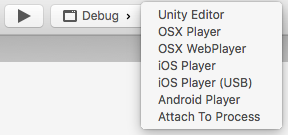 Play button and target list
With these steps completed, you are ready to being debugging your Unity scripts by clicking the play button.
Source Level debugging
The currently open source files are shown as tabs in MonoDevelop and can be edited there with the features of a standard text editor. However, there is also a grey breakpoint bar to the left of the editor panel. Clicking in this bar will add a so-called breakpoint marker next to the line of code.
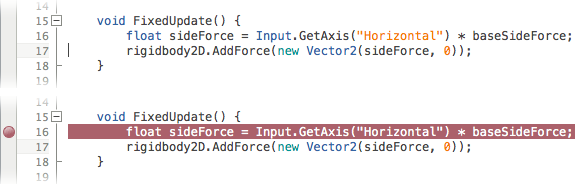 Breakpoint being added to code on line 16
Adding a breakpoint to a line instructs Unity to pause execution of the script just before it reaches that line during Play mode. When the script is “frozen” like this, you can use the debugger to determine exactly what the script is doing.
 The arrow shows execution paused at the breakpoint
Information about the state of execution is shown in the tabs at the bottom of the MonoDevelop window when execution is paused at a breakpoint. Perhaps the most important of these is the Locals tab.
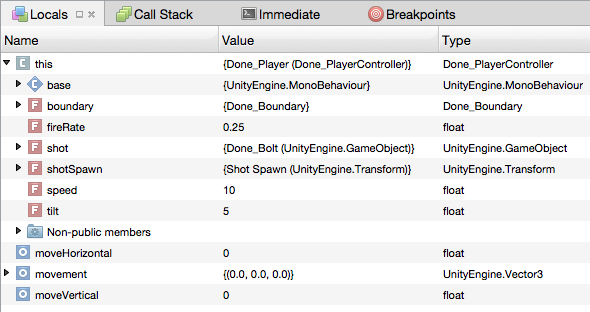 Tab showing variable values
A further useful feature of MonoDevelop is single stepping. When execution is paused at a breakpoint, a bar of debugging tools will become available in the top portion of the MonoDevelop window:-
 MonoDevelop stepping tools
The four buttons are known as Continue, Step Over, Step In and Step Out and can also be accessed as commands on the Run menu. Continue resumes execution until the next breakpoint is encountered. Step Over and Step In both execute one line of code at a time. The difference between the two is that Step Over executes any function calls within the line all at once, while Step In allows the stepwise execution to continue into the function. Since it is common to use Step In accidentally on a function that is known to be correct, Step Out continues execution to the end of the current function and then pauses again in the code that originally called it.
A detailed description of source level debugging techniques is not appropriate here but there are various books and web resources offering wisdom on the subject. Additionally, a little experimentation will help you get a feel for the power of the technique and how you can use it to track down most common types of bugs.